
About Us
Webster University is an independent nonprofit institution with a century of time-tested results, today serving 13,000-plus students studying worldwide. Recognized for its diversity, inclusion and global orientation, Webster is an institution focused on the future of education, guided by a bold mission appropriate for today's changing times.
With its main campus in St. Louis, Missouri, USA, Webster’s global network of campuses spans three continents. Faculty, staff, students and alumni from across the network forge powerful bonds with each other and their communities around the globe, guided by the University’s mission, vision and core values.
Mission
Webster University nurtures the skills, knowledge and personal growth of our students, cultivating learners who are engaged citizens, ready to create meaningful change in their communities and the world.
Vision
Webster University empowers our students to become catalysts for change — transforming their own lives while driving progress and inspiring lasting impact in communities worldwide.
Our Core Values
Webster provides hands-on, experiential learning, offering students high-impact experiences through internships, mentorship, research, community service and study abroad opportunities. The University is committed to providing a transformative education for students, emphasizing critical thinking and creativity and fostering a student-first environment.

We understand that we are interconnected and greater than the sum of our parts. By leading with love, Webster creates a community that is the heart of learning and growth. Through a shared ethic of care and compassion, we promote a culture of belonging that empowers each person to contribute their unique perspectives. By embracing dialogue, mutual respect and social responsibility, we nurture individuals who contribute to the common good within our campus communities and on a global scale.

Webster’s unwavering commitment to diversity, equity and inclusion is rooted in the fundamental belief that every person has equal worth. The University’s commitment to diversity, equity and inclusion extends to all individuals from historically underrepresented and marginalized groups. Recognizing the complexities of intersectionality and the commitment to ongoing education, inclusivity and equity for all, Webster maintains a community with a sense of belonging for all identities. It ensures everyone can learn, work and live in an atmosphere of dignity, respect, safety and care.
Our differences make us stronger, which is why Webster insists on a culture of fairness and kindness. The University amplifies the contributions of students, faculty and staff, knowing that diversity and mutuality fuel innovation, creativity and success in everything our community accomplishes.

The highest standards of honesty, fairness and accountability are upheld in all aspects of the community’s academic and professional lives. This commitment requires authentic discourse, transparency, courage and a dedication to ethical principles, even in challenging circumstances. Webster creates a culture where trust thrives and people feel valued and safe to express themselves. The University builds a foundation of responsibility that extends into the communities we serve.

People are the greatest resource at Webster, and the institution is committed to responsibly caring for them, as well as the resources entrusted to the institution in ways that align with our values. Recognizing that it is a privilege to hold the trust, time, talents and dedication of others, we actively care for the well-being and development of our students, faculty and staff.

We commit to growth and reflective practices that enhance our programs, processes and impacts, continually elevating our service to the community and advancing our mission. We embrace a mindset of lifelong learning, honest self-reflection and emotional intelligence, recognizing that personal development fuels innovation and strengthens our collective potential.

Webster Tbilisi

Based on the vision, mission and goals of Webster University, the branch in Georgia offers local and international students a high-quality education in Business Administration, International Relations, Mass Communications and Media Studies following international standards and ensures the preparation of highly qualified, competitive individuals for the Georgian and global labor market.
Regulatory Documents
Code of Ethics
Article 1. Scope and purpose of regulation
- This Code establishes ethical standards, principles and rules for all employees and students of the Georgia branch of Webster University, Inc. (hereinafter - the branch).
- The purpose of this code is to maintain high professional and ethical standards consistent with the reputation of Webster University in the teaching and research process of the branch.
- This Code complies with the laws of Georgia and the educational policy of Webster University.
Article 2. Obligation to observe ethical standards
- All branch employees, including administration, academic and invited staff, persons employed under temporary or permanent employment contracts and students of each educational program, are obliged to comply with high professional and ethical standards.
- Ethics standards, principles and rules established by this code cannot be used as a basis for restricting academic freedom guaranteed by the Constitution of Georgia.
Article 3. Principles of disciplinary proceedings stipulated by the Code of Ethics
- The purpose of the disciplinary proceedings provided for by the Code of Ethics is to quickly and fully reveal the violation of the Code of Ethics and determine the size of the proportionate disciplinary responsibility for the misconduct.
- Administrative proceedings stipulated by the Code of Ethics are based on the principle of the rule of law. No one can be held responsible without observing the basis and regulations established by the Code of Ethics.
- No one may repeatedly be subjected to disciplinary responsibility for the same misconduct.
- A person employed in the branch may not participate in disciplinary proceedings if he has a personal interest and/or if there is another circumstance that may affect the resolution of the case.
- Disciplinary proceedings provided for in this code are carried out in compliance with the principle of confidentiality.
- A person shall not be considered a perpetrator of a disciplinary offense until the decision on the ratio of the size of disciplinary responsibility for him enters into legal force.
Article 4. Obligation to respect the legislation
- All employees and students of the branch are obliged to be familiar with the legislation, legal acts and regulations related to the activities of the branch, which refer to their position, field of activity, rights and duties.
- All employees and students of the branch are obliged to follow the legislation and internal legal acts in force in the branch not only formally but also in accordance with its true purpose.
- The branch takes all measures to enable employees and students to access and familiarize themselves with the relevant regulations.
- The branch monitors the implementation of this code's ethical standards, principles and rules.
- Issues related to the implementation of ethical standards, principles and rules established by this code are considered in accordance with the relevant legal procedures.
Article 5. Obligation to operate in accordance with the mission of the branch and inadmissibility of conflict of interests
- All employees and students of the branch are obliged to fulfill their professional obligations in accordance with the mission of the branch.
- All employees and students of the branch should avoid conflicts of interest between their personal and official obligations and report conflicts of interest to the appropriate official of the branch.
Article 6. Obligation to observe the standard of academic integrity
- All employees and students of the branch are obliged to follow the standard of academic integrity.
- Plagiarism, falsification of facts, and misleading the addressee are prohibited.
- All research and student work in the branch must comply with the established rules, including the rules and requirements of research-funding state or private organizations.
- The works written by students within the framework of bachelor's and master's educational programs, including bachelor's and master's theses, will be uploaded to the Turnitin program for plagiarism checking.
- In the Turnitin program, plagiarism is determined for papers written within the framework of an undergraduate educational program, including a bachelor's thesis, if the rate exceeds 23%. For papers compiled within the framework of a master's educational program, including a master's thesis, plagiarism is determined if the rate exceeds 17%.
Article 7. Obligation to respect the rights and freedoms of others
- All employees and students of the branch are obliged to respect the rights and freedoms of others.
- Discriminatory treatment based on race, skin color, gender, origin, ethnic affiliation, language, religion, political or other views, social affiliation, property or rank, residence or other characteristics is not allowed.
Article 8. Other types of violations of the code of ethics
The following action is considered unethical behavior and a violation of the code of ethics for all persons participating in the educational and research process:
- interfering with the educational process, including using a mobile phone in the auditorium when it is not used with the consent of the academic or guest staff and based on educational and research purposes;
- introduction, use or distribution of narcotic and/or psychotropic substances in the territory of the branch;
- introduction, use or distribution of alcoholic beverages in the territory of the branch;
- smoking tobacco or electronic cigarettes in the territory of the branch;
- gambling on the territory of the branch, its promotion or encouragement;
- delay in branch territory;
- damage to the material and technical means of the branch;
- bringing and/or distributing firearms, cold weapons, explosive, flammable substances in the territory of the branch;
- political, religious agitation or propaganda in the territory of the branch;
- Any action that intentionally interferes with the ongoing learning process advances the branch's mission or damages its reputation.
Article 9. Additional obligations for academic and visiting staff
The academic and visiting staff of the branch are obliged, among other rules established by the Code of Ethics, to comply with the following requirements:
- not to be late or miss lectures and seminars or other types of educational events, presentations, or conferences without good reason, and if there is a good reason, to warn the administration in writing;
- protect confidential information about students, colleagues, and persons involved in the educational and research process;
- to use teaching time and resources of the branch as efficiently as possible, only to achieve educational goals and objectives;
- take care of the material and technical resources of the branch and inform the administration in case of damage;
- not to verbally or physically insult students or colleagues;
- during the educational and research process, including during the assessment, not unreasonably give preference to any student or violate the student's rights on a discriminatory basis;
- not to evaluate colleagues negatively in the presence of students and colleagues;
- not to accept a gift or any other type of benefit from the student or any other person in exchange for writing an evaluation for the student or giving him any advantage;
- To ensure plagiarism control during student evaluation and to refer to the procedures established by this code when plagiarism is detected or suspected.
Article 10. Initiation of disciplinary proceedings
- The grounds for starting disciplinary proceedings are:
- a written statement of the branch employee regarding the initiation of disciplinary proceedings;
- existence of reasonable suspicion regarding alleged disciplinary misconduct;
- Results of external and/or internal education quality assurance and development monitoring.
- In the presence of any of the grounds provided for in the first paragraph of this article, the rector shall issue an order on the initiation of disciplinary proceedings, in which the identity of the alleged perpetrator of the disciplinary offense, the term of the disciplinary proceedings and the circumstances that formed the basis for the initiation of the disciplinary proceedings shall be noted.
- Disciplinary proceedings begin within one month after discovering disciplinary misconduct.
Article 11. Creation of Ethics Commission
- Disciplinary proceedings are conducted by the ethics commission created based on the rector's order.
- A representative of the branch's administration, a member of the academic council, representatives of the main educational units, a quality assurance manager, a person employed under an employment contract, a representative of academic or guest staff may be included in the ethics commission.
- The rector appoints the chairman and secretary of the ethics commission. The maximum number of members of the Ethics Commission is not limited but should be at least three members. In case of a split vote, the chairman's vote is decisive.
Article 12. Authority of Ethics Commission
- The Ethics Commission is authorized to:
- collect and study information on the circumstances and related facts mentioned in the order on the initiation of disciplinary proceedings;
- to receive and analyze written and/or oral explanations;
- confirm the presence or absence of disciplinary misconduct based on evidence;
- to determine the measure of disciplinary responsibility commensurate with disciplinary misconduct;
- to fulfill other obligations stipulated by this code and legislation.
- The Ethics Commission is independent in exercising its powers and is guided only by the legislation of Georgia, this code and other legal acts.
Article 13. disciplinary proceedings
- Information on the initiation of disciplinary proceedings is sent to the person alleged to have committed a disciplinary offense within five working days from the initiation of the disciplinary proceedings or the identification of the person unless the notification may interfere with the interests of carrying out the disciplinary proceedings.
- The person alleged to have committed a disciplinary offense shall be given a deadline for submitting a written explanation, which shall not be less than three working days.
- If the written explanation submitted by the alleged perpetrator of the disciplinary offense is incomplete or additional documentation is required, he/she will be notified, and a deadline for submitting additional documentation will be set, which should not be less than two working days.
- The Ethics Commission must explain to the alleged perpetrator of disciplinary misconduct his rights and duties to introduce him to the rules of disciplinary proceedings and case materials.
- The Ethics Commission must include in the disciplinary proceedings the person who has information about disciplinary misconduct and can submit a written or oral explanation.
Article 14. Oral hearing
- The Ethics Commission is obliged to conduct an oral hearing with the participation of the person who allegedly committed the disciplinary offense unless the person refuses to participate in the oral hearing.
- Interested parties must be notified of the oral hearing at least seven days before its holding and invited to participate in the oral hearing.
- The invitation specifies the authority of the ethics commission to consider and decide the case even without the participation of the interested party.
- The oral hearing should typically last up to one working day.
Article 15. The procedure for conducting the oral hearing
- The session is opened and presided over by an authorized official of the Ethics Commission.
- The authorized person of the Ethics Commission and the branch, the interested party, and the person invited to the discussion have the right to participate in the oral hearing.
- The session's chairman is obliged to ensure the examination of the circumstances essential to the case at the oral hearing and to give the attending interested party the right to express his opinion regarding the matter.
- The interested party has the right to file a petition regarding the investigation of circumstances essential to the case.
- The session's chairperson ensures the maintenance of order at the session. He has the right to warn the person violating the order and, in exceptional cases - to expel him from the hall.
- The session can continue without the participation of the person expelled from the hall.
Article 16. Minutes of the oral hearing session
- Minutes are made during the session.
- The protocol of the session should indicate the following:
- the name of the case on which the hearing is organized;
- composition of ethics commission;
- time and place of discussion;
- the identity of the chairman of the session, the interested party participating in the oral hearing, the expert, and the witness;
- the subject of the oral hearing and a brief overview of the case;
- If available, a brief description of witness statements.
- The chairman and secretary of the session sign the minutes of the session.
Article 17. Rights of the alleged perpetrator of disciplinary misconduct
A person alleged to have committed a disciplinary offense has the right to:
- to use the help of a lawyer;
- to request familiarization with the materials of the disciplinary proceedings;
- submit a written and/or oral explanation;
- submit evidence;
- to appeal the decision on the ratio of the size of disciplinary responsibility according to the law.
Article 18. Conclusion of the Ethics Commission
- As a result of the analysis of the materials obtained during the disciplinary proceedings,
the Ethics Commission concludes:
- about the existence of a disciplinary offense and the impossibility of applying the appropriate amount of disciplinary responsibility to a person or applying the amount of disciplinary responsibility;
- on the absence of disciplinary misconduct.
- In the conclusion provided by subparagraph "a" of the first paragraph of this article,
it should be noted:
- name, surname and status of the alleged perpetrator of the disciplinary offense (student,branch employee);
- the norm of the code of ethics, which the alleged perpetrator of disciplinary misconduct violated;
- description of disciplinary misconduct, time and place of commission;
- other information obtained by the Ethics Commission regarding disciplinary misconduct;
- appropriate justification of the specific sanction of the disciplinary responsibility for the person or the impossibility of the sanction of the disciplinary responsibility.
- In the conclusion in subparagraph "b" of the first paragraph of this article, the information obtained by the Ethics Commission and the relevant justification of the absence of disciplinary misconduct should be noted.
Article 19. Results of disciplinary proceedings
- The conclusion of the ethics commission is sent to the person who committed the disciplinary offense and to the rector.
- The rector makes one of the following decisions within seven working days after receiving
the conclusion of the Ethics Commission:
- regarding the ratio of the size of disciplinary responsibility for a person provided by the conclusion;
- Regarding the return of the conclusion with substantiated remarks to the Ethics Commission.
- The legal act provided for in subparagraph "a" or "b" of paragraph 2 of this article must be signed per the legislation's requirements.
- According to paragraph 3 of this article, the legal act is appealed according to the procedure established by the legislation of Georgia.
- If the existence of disciplinary misconduct is not confirmed as a result of the disciplinary proceedings, the rector terminates the disciplinary proceedings.
Article 20. Terms of disciplinary proceedings
- The term of disciplinary proceedings should be at most one month.
- If more than one month is necessary to establish the circumstances of essential importance for disciplinary misconduct, the rector decides to extend the period of disciplinary proceedings by no more than one month, ten working days before the expiration of the one month.
Article 21. The ratio of the measure of disciplinary responsibility
- The measure of disciplinary responsibility should be proportionate to the disciplinary misconduct.
- Regardless of the measure of disciplinary responsibility, the person is obliged to compensate the material damage caused to the branch due to disciplinary misconduct if this misconduct was committed intentionally or with gross negligence.
Article 22. Suspension and termination of disciplinary proceedings
- Disciplinary proceedings shall be stopped if criminal proceedings and/or administrative offense proceedings have been initiated against the alleged perpetrator of the disciplinary offense for the same action.
- The court's decision on the relevant criminal and/or administrative offense cases does not exclude the possibility of applying disciplinary liability due to disciplinary misconduct.
- Disciplinary proceedings shall be terminated if there is no longer an objective basis for disciplinary proceedings, and the rector's order shall be issued regarding this.
Article 23. The validity period of disciplinary responsibility
An employee of the branch is considered to have disciplinary responsibility for one year from the date of disciplinary responsibility and a student - for the entire study period until the end of studies.
Article 24. Measures of student disciplinary responsibility for violation of the code of ethics
- The branch is authorized to apply the following measures of disciplinary responsibility
for a student's violation of the Code of Ethics:
- written warning;
- cancellation of the results achieved in the training course;
- suspension or termination of the right to benefit from the financial benefit established by the branch;
- Termination of student status.
- Use of the measure of disciplinary responsibility provided for in subsection "a" of the first paragraph of this article is permissible in case of a light violation of the code of ethics.
- In case of academic dishonesty, including confirmation of plagiarism or attempted plagiarism, the measure provided for in subparagraph b of the first paragraph of this article is applied and, considering the severity of the misconduct, together with the measure provided for in subparagraph b of the first paragraph of this article, The measure of disciplinary responsibility provided for in subsection "c" as well.
- The measure of disciplinary responsibility provided for in subsection "d" of the first paragraph of this article is allowed only in case of severe violation of the norms of ethics established by this code.
- Violation of ethical norms is considered severe if:
- the reputation of the branch was damaged as a result of disciplinary misconduct;
- significant material damage was caused to the branch as a result of disciplinary misconduct;
- caused damage to another student or employee of the branch as a result of disciplinary misconduct;
- the student with disciplinary responsibility has committed a new disciplinary offense.
Article 25. Disciplinary measures of academic and visiting staff, administration employees or other persons appointed on the basis of the contract for violation of the code of ethics
- The branch is authorized to use the following measures of disciplinary responsibility
for violations of the code of ethics by academic and visiting staff or other employees
of the branch:
- verbal warning;
- written warning;
- Dismissal.
- The use of disciplinary measures provided for in subparagraphs "a" and "b" of the first paragraph of this article is permissible in case of a light violation of the code of ethics.
- The measure of disciplinary responsibility provided for in subsection "c" of this article's first paragraph is applied if a person has violated the Code of Ethics severely.
- Violation of ethical norms is considered severe if:
- Disciplinary misconduct caused damage to the reputation of the person who committed the disciplinary misconduct, which precludes the proper performance of official duties by this person in the future;
- the reputation of the branch was damaged as a result of disciplinary misconduct;
- significant material damage was caused to the branch as a result of disciplinary misconduct;
- a student or other employee of the branch was harmed as a result of disciplinary misconduct;
- the person with disciplinary responsibility has committed a new disciplinary offense.
- The rector has the right to remove the alleged perpetrator of disciplinary misconduct from the service during disciplinary proceedings.
Financial management policy - Financial Management, Control and Accountability Provisions
Article 1. Purpose and scope of regulation
- This rule establishes the financial management policy of the Webster University, Inc. branch in Georgia (hereinafter - the branch), issues related to budget planning, implementation, monitoring and fulfillment of financial responsibilities.
- The effect of this rule applies to the financial activities of the branch and the management bodies, structural units and employees involved in this activity.
Article 2. Basic principles of finance management policy
The main principles of finance management policy are:
- budget planning and management in accordance with the long-term and short-term strategic goals of the branch;
- compliance with the requirements of the legislation in the process of budget planning, development, control and accountability;
- reasonable distribution of financial resources to achieve the educational and scientific goals of the branch and to strengthen its potential;
- effective distribution and management of the financial resources of the branch in order to increase the competitiveness of the branch;
- In the process of planning, management, control and accountability of the branch's finances, ensuring the involvement of the interested parties in an appropriate manner and taking into account their opinions.
Article 3. Management bodies and structural units participating in the process of financial management, control and accountability
- Management bodies and structural units participating in the process of financial management,
control and accountability are:
- General Assembly;
- Rector;
- Vice-Rector;
- Finance manager.
- Branch management bodies and structural units specified in the first paragraph of this article are obliged to comply with the requirements established by Georgian legislation in the process of financial planning, implementation, monitoring and accountability.
Article 4. Powers of management bodies and structural units
- In the process of managing the finances of the branch, the General Assembly is authorized
to:
- to approve the annual budget of the branch upon the presentation of the Rector;
- to give consent to the Rector in order to sign documents of a financial nature;
- to control the budget implementation process and request the Rector to submit a budget implementation report.
- In the process of managing the finances of the branch, the Rector is authorized to:
- with the consent of the General Assembly, to sign the documents of financial quality;
- implement budget management, performance control and reporting to the General Assembly.
- The Vice-Rector, within the Rector's powers and in order to promote his activities, manages the budget of the branch, controls and reports.
- The finance manager carries out operations related to the finances of the branch and ensures the preparation of relevant financial documentation.
- When making decisions in the branch finance management process, the finance manager is responsible to the Vice-Rector, the Vice-Rector to the Rector, and the Rector to the General Assembly.
Article 5. Financial Policy Council and its composition
- To implement the system of effective financial management, control and accountability,the Financial Policy Council is established.
- The composition of the Financial Policy Council includes:
- Vice-Rector (Chairman of the Council);
- head of administration;
- Finance Manager (Council Secretary).
- The financial policy council of the branch is an advisory body of the Rector.
- The Rector approves the composition of the Financial Policy Council.
Article 6. Functions of the Financial Policy Council
- The main function of the Financial Policy Council is to ensure the effectiveness of the branch's financial activities, compliance with the legislation, making effective financial decisions and implementing a control and accountability system.
- Powers of the Financial Policy Council:
- Formulation of Financial Policy: The Financial Policy Board formulates the financial policy relating to various aspects of the branch's financial operations. This includes budgeting, investing, financial reports;
- Risk management: The Financial Policy Council assesses financial risks and develops strategies to overcome financial risks. This may include market risks, credit risks, operational risks and compliance risks;
- Budget supervision: the Financial Policy Council supervises the budgeting process ensures compliance of the budget with the branch's strategic development and action plan;
- Financial planning: the financial policy board participates in the development of long-term financial plans of the branch, including the determination of investment strategy, debt management and diversification directions;
- Compliance with regulations: the financial policy board ensures compliance with relevant financial laws, as well as compliance with accounting standards and internal policies;
- activity monitoring: the Financial Policy Council monitors the extent to which the financial activities comply with the defined goals, examines the financial reports and evaluates the branch's financial condition and sustainability;
- Communication with interested parties: the Financial Policy Council cooperates with key interested parties, including branch management bodies, structural units, main educational unit, students and external partners on issues related to branch finances;
- The Financial Policy Council assesses the financial sustainability and risks of the branch's individual educational programs, develops a financial strategy, establishes a draft budget, discusses issues related to purchases, prepares quarterly financial reports on income and expenses, develops proposals related to tuition fees, and monitors the timely payment of tuition fees.
- Proposals and projects provided for in paragraph 2 of this article will be submitted by the financial policy council to the Rector for approval, who will approve the submitted document in accordance with the competence and powers defined by the branch charter.
- The session of the Financial Policy Council is authorized if the majority of the full composition is present, and the decisions are made by the majority of the members present.
- The Chairman of the Financial Policy Council will lead the meeting according to the agenda. Before the meeting, the Chairman shares relevant information with the members, including information about the issues to be discussed and draft documents. Decisions are made at the meeting based on discussion, analysis and discussion of the issues specified in the agenda. After making the decision, the Financial Policy Council monitors the implementation process.
- Decisions of the Financial Policy Council are made in minutes and signed by the chairman and secretary.
- The Financial Policy Council is accountable to the Rector.
Article 7. Financial analysis of educational programs
- The Financial Policy Council shall submit to the Rector an annual report containing a financial analysis of the branch's educational program.
- The annual financial report of educational programs shall include, among other things, an analysis of income and expenses and information on risks, forecasts and recommendations.
Article 8. Financial support measures for students
- Financial Policy Council for financial support of students:
- examines and determines proposals for student financial support measures, which may include, among others, scholarships, grants, and student project support;
- based on the results of the financial analysis, develops flexible mechanisms for the payment of tuition fees, which are adjusted to the interests of the student and take into account the financial sustainability goals of the institution;
- Develop financial support measures for students with difficult socio-economic conditions, which may include reduced tuition fees and/or different and flexible mechanisms for tuition fee payment.
- The financial policy council shall submit the proposals and documents established by the first paragraph of this article to the Rector for approval.
Article 9. Planning and implementation of procurement process
- To conduct educational and research activities qualitatively, the Financial Policy Council plans and implements the procurement process.
- The Financial Policy Council ensures full compliance of the procurement process with the requirements of Georgian legislation.
- To plan and implement procurement, the Financial Policy Council receives information from all interested parties, including the needs of management bodies, as well as the needs of individual structural units, academic and invited staff, students and other interested parties whose satisfaction is necessary for the quality of the educational and research process.
- All interested parties, including branch management bodies, structural units, academic and visiting staff and students, are entitled to write to the Financial Policy Council and submit requests for procurement planning and implementation. The request must be justified.
- Purchases are made within the budget approved by the General Assembly.
Article 10. Development and approval of the branch budget
- The Financial Policy Council manages the budget development process of the branch.
- The budget project of the branch should be developed before the beginning of the academic year.
- During the development of the budget, the following should be taken into account:
- financial resources necessary for the activities of the main educational unit;
- financial resources necessary for the activities of management bodies;
- financial resources necessary for the activity of structural units;
- financial resources necessary for the activities of academic and guest personnel;
- financial resources necessary for the implementation of each undergraduate educational program;
- financial resources necessary for the implementation of each master's educational program;
- financial resources necessary for achieving the goals and objectives defined by the branch's strategic development and action plans;
- financial resources necessary for the implementation of other types of activities and activities of the branch.
- The Financial Policy Council draws up the draft budget in accordance with the pre-established form.
- The financial policy council will submit the draft budget to the Rector for consideration. The budget, presented by the Rector, is approved by the General Assembly.
- The budget planning process begins on June 1st and ends on September 1st with the issuance of the legal act of budget approval.
Article 11. The rule of making changes to the budget
- Amendments to the branch's budget are allowed at any time during the year.
- Any management body of the branch, structural unit, academic and invited staff, and other interested persons have the authority to submit a proposal for making changes to the budget. The proposal to make changes in the budget should be justified.
- Amendments to the budget are included in how the budget is approved.
Article 12. Content of the budget
- The budget of the branch shall contain information about the income and expenses related
to the activities of the branch, including:
- educational activities;
- projects;
- donations;
- administrative expenses;
- expenses of academic and guest personnel;
- lease/sublease payments;
- marketing events;
- online resources, including the Internet;
- participation in social, cultural, and economic events, as well as in seminars, conferences and other activities;
- staff development;
- library resources;
- material resources;
- transportation costs;
- research activities;
- representative expenses.
- Along with the information specified in this article's first paragraph, the branch's budget may include other instructions and information necessary for the management, monitoring, reporting and educational and research activities of the branch.
Article 13. Carrying out daily financial operations
- The finance manager carries out daily financial operations within the scope of his powers. The Vice-Rector also has the authority to carry out financial operations thoroughly and independently within the budget.
- Financial activities of the branch are carried out, and financial operations are completed in national currency. Foreign currency is used and converted per the rules and rates established by the legislation of Georgia and the National Bank of Georgia.
Article 14. Monitoring of budget performance
- The Financial Policy Council regularly reviews and monitors the budget execution process.
- In implementing and monitoring the budget, the Financial Policy Council cooperates with the branch's management bodies and structural units and receives the necessary information.
- The General Assembly and the Rector also have the authority to monitor the budget and request budget monitoring at any time.
Article 15. Content of budget performance monitoring
- In the process of monitoring the implementation of the budget, the Financial Policy
Council verifies all types of information related to finances, including the following
information:
- current expenses;
- planned financial obligations;
- incomes;
- financial support of planned activities;
- compliance of expenses with the planned budget.
- Once every quarter, the Financial Policy Council reviews the accounting data and, if necessary, decides on submitting a budget adjustment proposal.
- In the case provided for by paragraph 2 of this article, budget corrections, changes, and additions are carried out in the manner in which the budget is approved.
Article 16. Internal and external audit
- the Rector can appoint an internal audit to check the financial activity.
- The external audit of the branch's financial activities is carried out at the established periodicity.
- To check the financial activity, the Rector can enter into a relevant transaction for audit evaluation.
- Internal and external audit evaluations are used to improve the financial performance of the branch.
Article 17. Financial documentation
- The branch ensures the storage of financial documentation in the manner and for the period established by the legislation of Georgia.
- The finance manager monitors the fulfillment of the obligations stipulated in the first paragraph of this article.
Internationalization policy
Since 1915, Webster University has provided a high-quality education to individuals who might not otherwise have had the opportunity to receive such an education. The university is proud of its rich heritage, which already consists of a global network of students, faculty, staff, and alums, and their activities aim to impact society around the world positively.
Webster University’s main campus is located in St. Louis, Missouri, USA. But, the university already has a strong presence in different countries. The university offers educational programs to students in North America, Europe, Asia, and Africa. In addition, the university creates online courses for interested parties to provide a diverse and inclusive learning environment.
Throughout its history, Webster University has remained true to its founding principles and mission - to offer students a high-quality education regardless of their background or social status.
Webster University’s attitude towards the internationalization policy was reflected in the decision to establish a branch in Georgia, which will serve as a quality education hub in the Caucasus region.
Branch of Webster University Inc. in Georgia (hereinafter - branch) students will be able to choose educational programs, including business, marketing, and media, and acquire the knowledge and skills needed in the modern global world.
The branch is committed to offering students the high-quality education necessary to succeed globally and individually.
Vision statement: The vision of Webster university is to be a premier U.S.-based international university setting a distinct standard for global education.
Mission statement: Webster University, a worldwide institution, ensures high-quality learning experiences that transform students for global citizenship and individual excellence.
Based on the vision and mission of Webster university, its goals are as follows:
- Regarding students: to sustain a personalized approach to global, student-centered education through small classes, close relationships with faculty and staff, and attention to student life;
- Regarding learning: to develop educational programs that join theory and practice, provide an international perspective, encourage creativity and scholarship, and foster a lifelong desire to learn and actively serve communities and the world;
- Regarding diversity and Inclusion: to create an environment accessible to individuals of diverse cultures, ages, and socioeconomic backgrounds and instill in students a respect for diversity and an understanding of their own and others’ values;
- Regarding global citizenship: to educate a diverse population locally, nationally, and internationally, act responsibly toward the environment to foster a sustainable future, and strengthen the communities.
Based on the vision, mission, and goals of Webster University, the mission of the branch is to offer local and international students high-quality, international-standard education in business administration, international relations, and mass communications and to provide training of highly qualified, competitive individuals for both the Georgian and global labor markets.
The internationalization policy of the branch is based on the main goals of higher education in Georgia established by the Law of Georgia “On Higher Education.” The main goals of higher education in Georgia are:
- Facilitating the formation of Georgian and world cultural values, orientation to the ideals of democracy and humanism, which are necessary for the existence and development of civil society;
- Meeting the needs of obtaining higher education, raising qualifications and retraining, and matching the interests and abilities of the person;
- Realization of personal potential, development of creative skills, training of persons with competence to match modern requirements, ensuring the competitiveness of persons with higher education in the domestic and international labor market, offering high-quality higher education following the demands of students and the general public to interested persons;
- To ensure the development of the state and the viability of the higher education system itself, training and retraining of new scientific personnel, creation, provision, and development of conditions for scientific research;
- To encourage the mobility of students and academic staff of higher educational institutions.
The goals of the internationalization policy of the branch are:
- Implementation of English-language undergraduate and graduate educational programs
recognized in the USA and awarding of qualifications recognized in Georgia and abroad
One of the primary and fundamental aspects of internationalization is the implementation of educational programs that are recognized both in Georgia and abroad. To promote internationalization, the branch will implement US-accredited educational programs to promote the mobility, qualification recognition, employability, and success of the branch’s students and graduates in the labor market. - Attracting international students
Internationalization policy is closely related to attracting international students. Without international students, no successful, world-recognized, high-quality higher education institution exists. Therefore, one of the main goals of the branch’s internationalization policy is to attract international students. - Attracting qualified international academic and visiting staff and administration
staff
The involvement of qualified international academics and visiting personnel, and administrative staff in the educational process is one of the main aspects of the successful internationalization of a higher educational institution. Internationalization is complex if it engages only with local staff. Therefore, the branch uses its strong side and involves an international team, including Webster network staff, in training. - Establishing partnerships with Webster University affiliates and other recognized
higher education institutions to encourage student and academic invited staff mobility.
International mobility is a critical component of successful internationalization. However, global mobility should concern students, academic staff, and invited personnel. The branch utilizes the resources of its founder, Webster University, and establishes relationships with Webster University branches in other countries and distinguished higher education institutions. - Establishing partnership relations with international companies in order to promote
practice and employment of students and graduates.
In the modern world, students choose higher educational institutions to be able to find employment in successful international companies. Therefore, the branch creates all the opportunities for students to get internships and jobs in distinguished global companies.
As a result of realizing the goals of the internationalization policy of the branch:
- Graduates will have the opportunity to be employed both in the local and international labor market;
- Academic staff will have the opportunity to improve their qualifications, gain experience abroad and share their knowledge with branch students;
- As a result of the international mobility of students, a diverse environment will be created on the campus of the branch, which will promote the integration of different international and Georgian students and the sharing of knowledge;
- With the introduction of educational programs, students will be able to receive quality American education in Georgia.
The Goal of the Internationalization Policy: Implementation of English-Language Undergraduate and Graduate Educational Programs Recognized in the USA and the Awarding of Qualifications Recognized in Georgia and Abroad (Objectives and Indicators)
- Introduction of an English-language undergraduate educational program in International
Relations:
- Obtaining permission from the Ministry of Education and Science of Georgia to implement an educational program in English
- The program is accredited by HLC (Higher Learning Commission) in the USA.
- Accreditation granted by the HLC (Higher Learning Commission) in the USA for the educational program is recognized by the National Center for Educational Quality Enhancement Center.
- Introduction of an English-language undergraduate educational program in Business
Administration:
- Obtaining permission from the Ministry of Education and Science of Georgia to implement an educational program in English
- The program is accredited by HLC (Higher Learning Commission) in the USA.
- Accreditation granted by the HLC (Higher Learning Commission) in the USA for the educational program is recognized by the National Center for Educational Quality Enhancement Center.
- Introduction of an English-language undergraduate educational program in Media Studies/Mass
Communications:
- Obtaining permission from the Ministry of Education and Science of Georgia to implement an educational program in English
- The program is accredited by HLC (Higher Learning Commission) in the USA.
- Accreditation granted by the HLC (Higher Learning Commission) in the USA for the educational program is recognized by the National Center for Educational Quality Enhancement Center.
- Introduction of an English-language graduate educational program in International
Relations:
- Obtaining permission from the Ministry of Education and Science of Georgia to implement an educational program in English
- The program is accredited by HLC (Higher Learning Commission) in the USA.
- Accreditation granted by the HLC (Higher Learning Commission) in the USA for the educational program is recognized by the National Center for Educational Quality Enhancement Center.
- Introduction of an English-language graduate educational program in Business Administration:
- Obtaining permission from the Ministry of Education and Science of Georgia to implement an educational program in English
- The program is accredited by HLC (Higher Learning Commission) in the USA.
- Accreditation granted by the HLC (Higher Learning Commission) in the USA for the educational program is recognized by the National Center for Educational Quality Enhancement Center.
- Introduction of an English-language graduate educational program in Media Studies:
- Obtaining permission from the Ministry of Education and Science of Georgia to implement an educational program in English
- The program is accredited by HLC (Higher Learning Commission) in the USA.
- Accreditation granted by the HLC (Higher Learning Commission) in the USA for the educational program is recognized by the National Center for Educational Quality Enhancement Center.
Goal of the Internationalization Policy: Attracting International Students (Objectives and Indicators)
- Offering programs focused on employment and occupations in demand in the market
- The branch offers international students professions in demand in the labor market. Specifically: International Relations, Business Administration, Media Studies/Mass Communications
- The above qualifications/programs are offered at undergraduate and graduate levels.
- Place the branch campus in an attractive location for students and promote the location
- The branch campus is located in a location that is attractive and easily accessible to students.
- A lease agreement has been signed for the appropriate term in connection with the use of campus space.
- Offering a flexible educational process
- The branch offers students a flexible learning process, offering online and in-person learning courses.
- Students can use Webster University’s online resources, including the online library
- Creating attractive career advancement opportunities
- The branch provides students with the opportunity to benefit from exchange programs.
- The branch allows students to benefit from applicable and attractive learning practices.
- Creating a supportive environment
- The campus environment is tailored to the needs of international students.
- Campus administrative and academic, and visiting staff advise international students.
- Website optimization
- An English version of the website has been created.
- The website performs a communication function, including for international students.
- Organization of virtual/online tours and meetings
- The branch creates virtual tours/online meetings for international students and introduces the features and perspectives of studying in the Georgian branch.
- Create video content
- The branch creates video content to introduce international students to the campus, curriculum, and programs
The Goal of the Internationalization Policy: To Attract Qualified International Academic and Visiting Staff and Administrative Staff (Objectives and Indicators)
- Attracting qualified international academic staff
- International instructors and highly qualified academic staff members of the Webster network are involved in the training process of the branch.
- A competition was held by the rules established by the legislation of Georgia and the internal legal acts of the branch for the selection of international, including academic staff members of the Webster network.
- Attracting qualified international guest personnel
- International staff members are involved in the training process of the branch, including highly qualified guest staff/lecturers who are members of the Webster network.
- International invited staff members who have joined the Webster network are selected according to the rules established by Georgia's legislation and the branch's internal legal acts.
- Appointment of qualified international administrative personnel in management bodies
and structures
- Qualified expatriates participate in the management bodies and structures of the branch, including administrative staff members of the Webster network.
- Qualified expatriates, including administrative staff members of the Webster network, are appointed in the management bodies and structural units under Georgia's legislation and the branch's internal legal acts.
Internationalization Policy Objective: Establish Partnerships with Webster University Affiliates and Other Recognized Higher Education Institutions to Encourage Student and Academic and Visiting Staff Mobility (Objectives and Indicators)
- Establish partnerships with Webster University branches to encourage student and academic
staff and invited personnel mobility
- Mobility rate of students and academic and visiting staff.
- Establishing partnerships with higher education institutions to encourage student
and academic staff and invited personnel mobility
- Memorandums of understanding have been signed with recognized higher educational institutions to encourage the mobility of students and academic staff and invited personnel.
The Goal of the Internationalization Policy: To Establish Partnership Relations with International Companies to Promote the Practice and Employment of Students and Graduates (Objectives and Indicators)
- Selection of international companies
- To establish a partnership relationship, those international companies where it is possible to undergo practice and/or employment of branch students are constantly selected.
- Establishing partnerships with international companies
- Memorandums have been signed with pre-selected international companies to promote the practice and employment of students and graduates.
The quality assurance manager is the main structural unit responsible for the control and reporting of the achievement of the goals of the internationalization policy. All structural units of the branch provide the quality assurance manager, upon his/her request, with all the necessary information to evaluate the achievement of the goals of the internationalization policy.
The quality assurance manager reports on the achievement of the goals of the internationalization policy to the academic council, the vice-rector, and the Rector.
The Rector is authorized to discuss issues related to achieving internationalization goals with the General Assembly.
Amendments and additions to the internationalization policy document can only be made with proper justification and in the manner established by the branch's legislation and internal legal acts.
IT Continuity Plan for Webster University Georgia
Purpose and Scope of the IT Continuity Plan
Purpose: The purpose of the IT continuity plan is to ensure the uninterrupted availability and functionality of critical IT systems, applications, and data in the event of any disruptive incidents or disasters in Webster University, Inc. Branch in Georgia (hereinafter - Branch). This plan aims to minimize the impact of such incidents on the university's operations, safeguard valuable information, and maintain essential IT services for faculty, staff, and students.
Scope: The IT continuity plan covers all aspects of the university's IT infrastructure, including hardware, software, data centers, network infrastructure, and IT personnel. It encompasses a wide range of potential threats such as natural disasters, cyber-attacks, equipment failures, and other unforeseen events that could compromise IT services. The plan outlines comprehensive strategies, response procedures, and recovery mechanisms to address various levels of disruption and prioritize the restoration of critical IT systems.
Overview of the University's IT Infrastructure and Critical Systems
The university's IT infrastructure is a complex ecosystem that supports various academic, administrative, and research activities. It comprises the following critical components:
- Data Center: The university hosts centralized data centers that house servers and storage systems for applications, databases, and academic resources.
- Network Infrastructure: A robust network infrastructure connects all the stakeholders. It includes wired and wireless networks, routers, switches, and firewalls and VPNs. Wired network is divided to an academic and staff partitions, access regulated by the user tier.
- Academic Applications:
- CX (powered by Jenzabar) is an enterprise application system that supports, student and administrative services such as course registration, showing course information, and viewing academic records. CX is available globally to all faculty, staff and students. CX capacity and usage are monitored regularly.
- Connections (powered by Microsoft Sharepoint) is a web portal, a single point of access to many of the online services. It integrates online courses, online registration, grade entry, billing information, and more into a single web-based interface that can be accessed from any internet-capable device.
- Connections is available globally to all faculty, staff and students
- Connections capacity and usage are monitored regularly.
- LMS “WorldClassroom” (powered by learning management system Canvas by Instructure) is the portal used for all of Webster's online courses. It includes many tools and features that help make the online learning experience efficient and intuitive.
- WorldClassroom is available globally to all faculty and students
- WorldClassroom capacity and usage are monitored regularly. WorldClassroom is sized to support all current and future growth of the branch.
- Administrative Systems: These systems manage student records, financial transactions, human resources, payroll,
and other administrative functions:
- Faculty and Staff CX (powered by Jenzabar) is an enterprise application system that supports, all administrative services such as course registration, showing course information, and viewing academic records. CX is available globally to all faculty, and staff. CX capacity and usage are monitored regularly.
- Connections (powered by Microsoft Sharepoint) is a web portal, a single point of access to many of the online services. It integrates online courses, online registration, grade entry, billing information, and more into a single web-based interface that can be accessed from any internet-capable device.
- Connections is available globally to all faculty and staff.
- Connections capacity and usage are monitored regularly.
- Email and Collaboration Tools: University-wide email services and collaboration platforms facilitate communication and information sharing among faculty, staff, and students. All of the email services of Webster University Georgia are powered by Microsoft Outlook.
- Website and Online Services: The university's official website www.webster.edu.ge, provides information, resources, and services to a general public all university community services are provided by the access regulated intranet: “Connections Portal”.
Key Stakeholders and Their Roles in the Continuity Process
- IT Leadership Team: Webster University Georgia Information Technology team comprises of the Branch IT manager and both US and Global Headquarters team. They are responsible for overall plan governance and coordination. The plan is approved by the rector.
- IT Continuity Planning Committee: Webster University Georgia has a collaborative plan of Information Technology development and continuity. Comprising representatives from different structural units, they collaborate in developing, reviewing, and updating the continuity plan.
- Incident Response Team: Webster University Georgia employs IT Manager. IT manager accesses the incidents and initiates response procedures, and coordinate recovery efforts.
- Staff: They play a critical role in adhering to the continuity plan, reporting incidents, and following procedures to ensure minimal disruption.
- Natural Disasters: Earthquakes, hurricanes, floods, wildfires, and other natural disasters can cause physical damage to data centers, network infrastructure, and IT equipment.
- Cyber-Attacks: Malware, ransomware, distributed denial of service (DDoS) attacks, and hacking attempts can compromise data integrity, disrupt IT services, and lead to data breaches.
- Power Outages: Electrical failures, grid issues, or infrastructure damage can result in power outages, affecting critical IT systems and causing downtime.
- Hardware Failures: Components like hard drives, power supplies, or networking devices may fail unexpectedly, leading to service disruptions and data loss.
- Human Errors: Accidental data deletion, misconfigurations, and operational mistakes by staff can lead to service interruptions and data corruption.
- Software Vulnerabilities: Unpatched or outdated software may contain vulnerabilities that can be exploited by attackers, potentially disrupting services or compromising data.
- Telecommunication Failures: Outages in internet connectivity or telecommunication services can impact online learning, communication, and access to cloud-based resources.
- Supply Chain Disruptions: Dependence on third-party vendors for critical hardware or software components can lead to disruptions if the supply chain is interrupted.
- Social Engineering: Phishing, pretexting, and other social engineering techniques can be used to gain unauthorized access to systems and sensitive data.
- Malicious Insiders: Disgruntled employees or students with privileged access can intentionally cause disruptions or compromise data.
- Natural Disasters:
- Impact: Extended downtime, data loss, disruption of academic activities, delayed submission of assignments, and temporary closure of the university.
- Cyber-Attacks:
- Impact: Breach of sensitive data (student records, research findings), loss of intellectual property, financial losses due to ransom payments, and reputational damage.
- Power Outages:
- Impact: Complete interruption of IT services, halting online classes, restricted access to online resources, and potential data corruption.
- Hardware Failures:
- Impact: Downtime, loss of data stored on affected hardware, and disruption of specific services or applications.
- Human Errors:
- Impact: Data loss, downtime, temporary unavailability of critical services, and potential compromise of sensitive information.
- Software Vulnerabilities:
- Impact: Exploitation of vulnerabilities leading to unauthorized access, data breaches, and disruption of services.
- Telecommunication Failures:
- Impact: Limited or no access to online resources, communication disruptions, and delays in academic activities.
- Supply Chain Disruptions:
- Impact: Delayed procurement of essential IT components, leading to extended downtime and potentially increased costs for urgent replacements.
- Social Engineering:
- Impact: Unauthorized access to systems, compromised accounts, and potential data breaches.
- Malicious Insiders:
- Impact: Sabotage of IT systems, data breaches, and disruption of critical services.
Conducting a thorough impact analysis allows the branch to prioritize risk mitigation efforts and allocate resources to the most critical areas of concern. It also enables the development of appropriate response and recovery plans tailored to the potential consequences of each identified threat.
Identify critical IT systems, applications, and data required for essential branch functions Prioritize IT assets based on their impact and recovery time objectives (RTOs) and recovery point objectives (RPOs)
Identifying critical IT systems, applications, and data is crucial for prioritizing recovery efforts during IT disruptions. These assets are essential for the university to continue its core functions and maintain business continuity. Here are some examples of critical IT assets and their associated functions:
Prioritizing IT Assets based on RTOs and RPOs:
Recovery Time Objective (RTO): The maximum acceptable downtime for a system or application before it must be restored and operational again.
Recovery Point Objective (RPO): The maximum acceptable data loss that is considered tolerable in the event of a recovery. In other words, how much data can be lost before it significantly affects the university's operations.
Priority for recovery is generally assigned based on the criticality of each asset, RTO, and RPO. Here's a suggested prioritization:
- Tier 1 - High Priority:
- LMS: RTO - Within hours, RPO - Minimal data loss (minutes if possible)
- SIS: RTO - Within hours, RPO - Minimal data loss (minutes if possible)
- Email and Communication Services: RTO - Within hours, RPO - Minimal data loss (minutes if possible)
- Tier 2 - Medium Priority:
- Financial Management System: RTO - Within 24 hours, RPO - Minimal data loss (hours if possible)
- Human Resources Management System: RTO - Within 24 hours, RPO - Minimal data loss (hours if possible)
- Research Databases and Applications: RTO - Within 24 hours, RPO - Minimal data loss (hours if possible)
- Tier 3 - Lower Priority:
- Library Management System: RTO - Within 48 hours, RPO - Minimal data loss (hours if possible)
- Online Collaboration Tools: RTO - Within 48 hours, RPO - Minimal data loss (hours if possible)
- Admission and Enrollment Systems: RTO - Within 48 hours, RPO - Minimal data loss (hours if possible)
Note: The RTOs and RPOs provided above are general guidelines and may vary based on the specific needs and requirements of the branch. The actual values should be determined through consultation with relevant stakeholders and a thorough risk assessment process.
Define strategies to mitigate risks and ensure IT service availability during disruptions, including: Data backup and recovery procedures, Redundant systems and failover mechanisms, Cloud-based solutions and remote access capabilities, Alternate communication channels for stakeholders
Data Backup and Recovery Procedures:
Strategy: A robust data backup and recovery process is implemented to ensure the availability and integrity of critical data in the event of data loss or corruption.
Key Actions:
- Regularly back up all critical data, including databases, files, and configurations is performed every night from the local data center to the virtual server.
- Each computer on Webster network has a unique image for the cases of the physical damage.
- The periodic recovery tests are conducted to verify the effectiveness of the backup process.
Redundant Systems and Failover Mechanisms:
Strategy: Deploy redundant IT systems and failover mechanisms to provide continuous service availability even if primary systems experience failures.
Key Actions:
- Webster University implements redundant hardware components (e.g., servers, switches, power supplies) in critical systems, in case of failure of any of items, back up resources are deployed.
- Since most of the data centers are cloud based Webster University Georgia implemented UPS connected to the main server that allows ample amount of time to back up new data, and properly exit the system.
- At the instance of any outages, IT manager contact Global IT team to go over the logs to identify and test the issues to ensure they function as expected.
Cloud-Based Solutions and Remote Access Capabilities:
Strategy: Webster University Georgia is using cloud-based solutions and enable remote access capabilities to support continuity during disruptions that affect physical access to campus facilities.
Key Actions:
- All critical applications and data are migrated to the reputable cloud service providers with strong security measures.
- The cloud-based services offer high availability and redundancy.
- All of the accesses to the systems are enabled to be controlled remotely, by every stakeholder, and are controlled by the level assign by the IT.
- All the users are trained about remote access procedures and security best practices.
Alternate Communication Channels for Stakeholders:
Strategy: Webster has alternate communication channels to facilitate continuous communication with stakeholders during disruptions.
Key Actions:
- Webster uses multiple communication channels, such as email, text messages to reach faculty, staff, and students.
- During emergencies webster university issues Rave Alert to all stakeholders.
By implementing these IT continuity strategies, the university has significantly enhanced its resilience to potential disruptions and maintained essential IT services during challenging situations. Regular testing, training, and coordination with stakeholders have been essential to ensure the effectiveness of these strategies when faced with real-world disruptions.
Additionally, updating the strategies periodically based on lessons learned from past incidents has further improved the university's preparedness for future events.
An Incident Response Plan has been established, including an incident response team and defined roles and responsibilities. The process for reporting IT incidents and activating the continuity plan has been detailed, along with procedures for assessing the severity of incidents and escalating as necessary.
Incident Response Team and their Roles:
- Incident Response Manager: Overall responsible for managing the incident response process, coordinating with stakeholders, and overseeing the resolution efforts.
- IT Security Team: Investigates and mitigates security-related incidents, such as cyber-attacks, unauthorized access, and malware infections.
- IT Operations Team: Addresses incidents related to system and application failures, hardware issues, and service disruptions.
- Communications Team: Manages internal and external communication during incidents, ensuring stakeholders are informed about the situation and recovery progress.
- Legal and Compliance Team: Ensures that incident response actions comply with legal, regulatory, and contractual obligations.
- HR Manager: Deals with incidents involving human resources, such as insider threats, policy violations, or personnel-related issues.
Reporting IT Incidents and Activating the Continuity Plan:
Process for Reporting IT Incidents:
- There is a dedicated email and phone number for the immediate assistance;
- Faculty, staff, and students are promptly reporting any suspicious activities or potential incidents they encounter to the Vice-Rector or the IT manager.
- Both Vice-Rector and IT manager identify what incident constitutes an IT incident and follow the plan further.
Activating the Continuity Plan:
- The Incident Response Manager is responsible for assessing the severity of the incident based on initial reports and determining if the continuity plan needs to be activated.
- If the incident poses a significant threat to IT services and operations, the Incident Response Manager initiates the continuity plan activation process.
Procedures for Assessing Incident Severity and Escalation:
Assessing Incident Severity:
- The Incident Response Team conducts an initial assessment of the incident to determine its impact and severity on critical IT systems, data, and operations.
- Severity levels can be categorized (e.g., low, medium, high) based on predefined criteria that consider factors like the extent of disruption, data loss, and potential consequences.
Escalation Procedures:
- Depending on the severity level, the Incident Response Manager escalates the incident to relevant stakeholders and higher management for awareness and decision-making.
- An escalation matrix defines the escalation path for different severity levels, ensuring that the right personnel are informed at each stage.
Example Severity Levels and Escalation Steps:
- Low Severity:
- Incident Response Manager notifies the relevant teams for investigation and resolution.
- Regular updates are provided to stakeholders.
- Medium Severity:
- Incident Response Manager escalates to Head of Administration for increased resources and coordination.
- A communication plan is initiated to inform affected parties about the incident.
- High Severity:
- Incident Response Manager notifies the branch's executive leadership, including the Rector and Vice-Rector.
- An emergency response meeting is convened to mobilize additional resources and support for rapid resolution.
- Communications are escalated to include the university's public relations and legal teams.
- Critical Severity:
- In the event of a severe incident, a formal crisis management team may be established, including representatives from various university departments and external experts.
- A crisis communication plan is activated to manage communication with stakeholders, media, and the public.
The branch has established and integrated effective incident response procedures that form a cornerstone of our operational framework. These procedures empower the branch to swiftly detect, respond to, and recover from IT incidents, effectively mitigating any disruptions to our operations and upholding uninterrupted continuity.
Central to our approach is the regular testing and continuous refinement of our incident response plan, a practice derived from insightful real-world incidents. This ongoing enhancement ensures that the branch remains well-prepared and capable of adapting our response strategies to the evolving landscape of challenges. By adhering to these established steps, the branch demonstrates its commitment to maintaining a robust and proactive incident response capability.
Recovery Procedures:
- Detailed Recovery Procedures: Comprehensive recovery procedures have been created for each critical IT system and application. These procedures meticulously outline the exact sequence of steps to be followed during the recovery process.
- Assigned Responsibilities: Specific team members have been assigned responsibilities for each recovery task, facilitating a streamlined and organized recovery effort.
- Sequenced Recovery: The recovery process has been clearly sequenced, allowing for a systematic and efficient restoration of critical IT systems and applications.
- Verification Checkpoints: Checkpoints have been integrated into the recovery process to ensure that successful recovery is validated at different stages, guaranteeing the accuracy of the restoration.
- Communication Plan: The branch has established a robust Communication Plan to ensure
stakeholders are well-informed during IT disruptions:
- Designated Spokespersons: Official spokesperson(s) have been identified and tasked with communicating directly with stakeholders during incidents.
- Tailored Communication Channels: Appropriate communication channels for various incident types have been determined, ensuring effective and targeted communication.
- Training and Testing: The branch has implemented comprehensive Training and Testing
initiatives:
- Employee Training Programs: Regular training sessions are conducted to familiarize employees with their roles during incidents. Employees receive guidance on reporting incidents, following procedures, and utilizing communication channels effectively.
- Regular Plan Testing: Mock drills and exercises are periodically scheduled to simulate various IT incidents. These exercises evaluate the effectiveness of the incident response procedures.
- Stakeholder Participation: Stakeholders from diverse structural units are actively engaged in the testing process to ensure a cohesive and coordinated response.
- Continuous Improvement: Mock drill results are analyzed to identify areas for enhancement. Real incident experiences are integrated into the plan to continually improve its effectiveness.
- Resource Requirements: Resource management is a prioritized aspect of the university's
IT Continuity Plan:
- Inventory of IT Resources: The university has cataloged the necessary hardware, software, and network resources required for plan implementation and maintenance.
- Human Resources Planning: Human resource requirements, including skill sets and training needs, have been determined.
- Budget Allocation: A dedicated budget has been developed to support the implementation and maintenance of the IT continuity plan.
- Funding Sources: Funding sources, including the IT manager budget and branch contingency funds, have been identified to sustain continuity efforts.
- Plan Maintenance and Review: Plan maintenance is an ongoing endeavor:
- Regular Reviews: The branch adheres to a schedule for regular plan reviews to ensure its currency and relevancy.
- Documented Changes: Modifications to the IT environment are meticulously documented to maintain accuracy.
- Gap Analysis and Enhancement: Periodic gap analyses are conducted to identify plan shortcomings. Corrective actions are taken to improve its effectiveness.
The branch's systematic organization of the IT continuity plan into these sections underscores its commitment to effectively addressing disruptions, safeguarding critical IT services, and maintaining operational continuity. The integration of regular reviews, testing, and updates ensures the plan's sustained effectiveness and adaptability over time.
Information Technology Management Policies and Procedures
This document sets forth Webster University, Inc's Branch in Georgia (hereinafter referred to as the Branch) information technology management policy and defines the procedures related to information technology management.
- The purpose of the information technology management policy and procedures is the effective and safe implementation of information technology in the branch's management, training and research activities and the continuous development of information technology systems.
- The branch's IT management policies and procedures also aim to ensure compliance with the GDPR (General Data Protection Regulation).
- All branch management bodies and structural units participate in implementing the branch's information technology management policy.
- The information technology manager is the central structural unit responsible for setting the information technology management policy and implementing relevant procedures.
- The branch is authorized to implement the information technology management policy and ensure the implementation of relevant procedures based on the agreement signed per the legislation of Georgia, as a result of receiving the service.
The branch's information technology management policies and procedures are based on the following principles and rules:
- compliance with the requirements of the legislation in force in Georgia in the field of information technologies is ensured;
- all employees and students of the branch are provided with free access to information and communication technologies and means of the branch using the appropriate personal account;
- everyone can freely use the internet services of the branch in the territory of the branch campus;
- the relevant agreement determines the scope of access to information technologies of the branch;
- only the information technology manager has the authority to monitor the management and use of the information accounts of the branch;
- the information and communication technical means owned or legally owned by the branch shall be temporarily transferred to the employees of the management bodies and structural units of the branch, as well as, if necessary, to the students during the term of the agreement signed with it;
- the customer uses the information and communication technical means of the branch only to fulfill the obligations specified in the contract signed with him;
- When using the branch with information and communication technical means, the user is obliged to comply with the requirements and contractual conditions established by the legislation of Georgia.
- The branch is obliged to protect the copyright and intellectual property of the academic and visiting staff, employees of management bodies and structural units, students, and partners of the branch, interested parties and other persons.
- The branch ensures the protection of copyright and intellectual property provided for in the first paragraph of this article per the legislation of Georgia, including the law of Georgia "On copyright and related rights".
- The branch is obliged to protect users' personal information in the information systems.
- It is not allowed to make personal data available to another person except when he has the consent of the relevant person per the established procedure or when access to personal data is allowed by the legislation of Georgia, including the General Administrative Code of Georgia and the Law of Georgia on "Personal Data Protection".
- Information about an identified or identifiable natural person is considered personal data. A person is identifiable when it is possible to identify him directly or indirectly, namely by an identification number or by physical, physiological, psychological, economic, cultural or social characteristics of a person.
- When processing personal data, the branch is guided by the legislation of Georgia, including the law of Georgia "On Personal Data Protection".
Unauthorized users may not have access to the branch's information and communication tools and the information contained in them.
- Only the information technology manager has the special authority to monitor information technology processes based on the rector's permission.
- In the information technology system, including the management of electronic programs/resources and databases, only the information technology manager can change the system parameters based on the rector's approval.
- It is not allowed to give confidential information, including commercial secrets, to a third party.
- Disclosure of confidential information is allowed only in the cases and according to the law.
To prevent the spread of viruses, eliminate software problems or protect the information and communication systems of the branch from any other type of damaging activity, monitoring of the information and communication network is allowed.
The branch has the right to restrict access to the information and communication means to the user who violates the rules of using the information and communication means or otherwise prevents the right to use the information and communication means in the prescribed manner.
- The branch mainly protects the existing information-technological means for which it uses, among others, environmental security and monitoring mechanisms.
- The branch protects information and communication facilities from cyber-attacks and the spread of viruses by installing appropriate anti-viruses and taking other appropriate measures.
- The branch ensures proper storage and creation of copies of data received during the management process and during educational and scientific activities.
- The branch provides customer support, including if the functionality of the user's personal information and communication facilities is threatened with loss of information and data.
- In the case provided for in paragraph 3 of this article, the branch is not responsible for the loss of information and data if this is caused by the user's use of personal information technology without appropriate protection of information and data and in violation of established rules.
The branch ensures the protection and recovery of information and data, including in power outages or other force majeure situations.
- To protect information and communication systems, the branch provides information
security, for which:
- identifies risks;
- will study a separate case;
- describes and evaluates risks and materialized cases;
- will develop response measures.
- If the risk cannot be prevented and the incident materializes, the branch ensures the immediate transfer of information about the incident to protect other undamaged information and data.
- In case of identified risks and/or materialized incidents, the information technology manager prepares a report, which is presented to the rector for consideration.
- All members of the branch's management body, each employee of the structural unit, academic and invited staff, and another person, if he cooperates with the branch in any other way, have a personal account for using information technology resources and e-mail.
- All students of the branch's undergraduate and graduate educational programs have a personal account for using information technology resources and e-mail.
- A personal account is created for the persons specified in the first paragraph of this article upon signing the relevant contract and for the persons specified in the second paragraph of this article - upon the emergence of the student status.
- The information technology manager of the branch ensures the creation of accounts for the persons provided for in paragraphs 1 and 2 of this article.
- The information technology manager provides information on creating personal accounts for branch employees by the branch human resources management manager, and the student admissions consultant provides student data.
- The personal account of the branch employee is canceled in case of termination of the relevant contract with him.
- In the case of completion of the educational program by the student, his account is maintained, and his e-mail is reflected in the alumni base of the branch.
- Suspension of the student's status does not lead to the student's personal account cancellation. In case of suspension of the status, the student has limited access to information technology resources.
- The password of the user's account is created to check the authenticity of the user. It protects the user's personal information placed in the information technology system.
- When creating a password, these rules must be followed:
- the password must contain both uppercase and lowercase letters of the Latin alphabet;
- The password must contain a number or other characters (for example, 92%@&-:_)
- the number of characters must be at least eight;
- It is not allowed to use such references as name, surname, date of birth, phone number, etc.
- Before forming the password provided in paragraph 2 of this article, the user receives a one-time password upon creation of a personal account, which the user changes upon first use.
- The branch's personal account user has the following obligations regarding password
management:
- It is not allowed to use the same password for branch accounts and other personal accounts;
- it is not allowed to share the personal account password with another person;
- it is not allowed to send the password by e-mail or other means of communication;
- it is recommended that the user does not hide the password in the browser;
- to comply with other reasonable password protection requirements while using the personal account and, in case of proper recommendation, to change/update the password.
- If there is a suspicion that the password may have been disclosed and/or there is a risk of password disclosure, then the user is obliged to change the password of the personal account immediately.
- An e-mail is created in the branch for all employees and students.
- The e-mail address is created based on the user's first and last name.
- If an e-mail has already been created according to the user's name and surname, then a serial number is added according to the order of registration.
- The e-mail is created by the information technology manager, to whom the human resources manager provides information about employees and information about students - by the student admissions consultant.
- Branch staff and students have an e-mail address @webster.edu, which is used for official communication between branch staff, academic and visiting staff, and students.
- It is not allowed to monitor the information and correspondence sent and received by the user by e-mail.
- When using e-mail, the user considers the following rules:
- it is prohibited to disseminate information about commercial activities to advertise these activities;
- Dissemination of political activity or support for political activity or any other information related to political activity is prohibited;
- spreading obscenity or false information, defaming another person, providing false information, fraud, intimidation, pressure on another person or committing any other illegal act through e-mail;
- Insulting another person using e-mail is not allowed.
- The use of the e-mail account will be suspended:
- upon termination of the employment contract with the employee of the branch;
- in case of termination of the student status or transfer according to the mobility rule;
- in case of use contrary to the e-mail legislation, this rule or the internal legal acts in force in the branch, as well as until the completion of the proceedings started to establish the fact provided for in this subsection;
- in case of dissemination of prohibited information;
- in case of gaining access to the user's e-mail by another person.
- The user may be restricted from using e-mail in the event of a technical problem in the information technology system of the branch, about which the information technology manager will immediately notify the user.
- It is forbidden to delete an e-mail account, including if the contractual relationship with the branch employee is terminated or the student's status is terminated.
- The information technology manager ensures smooth and proper operation of the branch's wired and wireless networks, data transmission infrastructure, databases and other types of servers.
- All technical work or software updates that cause network disruptions are carried out during non-working hours, and users are notified of network disruptions at least one day in advance.
- Internet addresses of information and communication facilities are distributed using a server, and its proper functioning and administration is ensured.
- A dynamic (temporary) or static (permanent) Internet address is assigned to information and communication devices included in the network.
- A static (permanent) Internet address is assigned for security purposes and in exceptional cases.
- Networking, installation and installation of all routers in the branch are carried out in compliance with security rules, which the information technology manager ensures.
- When using the router/router, it is ensured that the access password is stored in an encrypted form, the appropriate SNMP protocol is used for management and monitoring, and an encrypted channel (SSH) is used for remote routing configuration.
- Monitoring of network routing is carried out twenty-four hours a day, every day, and complete monitoring of network routing is carried out at least twice a year.
- The results of the monitoring report provided for in paragraph 3 of this article will be submitted to the rector.
- Access to wireless networks in the branch may be limited or free.
- In the case of a limited access network, the network access password is available only to authorized persons to whom the information technology manager informs the password.
- In the case of free access, access to the network is available to any person on campus who is given the password for access to the free network personally, by public posting on the campus or in some other way.
- Access to the wireless network is done with WPA2/PSK specifications and AES standards.
- All information technology devices in the branch network function according to information technology management policies and procedures.
- In case of violation or risk of breach of information technology management policies and procedures in any form, the branch is authorized to monitor specific information-technical means without content control.
- The function defined by paragraph 2 of this article is performed only by the manager of information technologies, who provides information about the monitoring results to the rector.
Methodology of Student Contingent Planning
- This rule defines the methodology for determining the contingent of students of the Webster University, Inc. branch in Georgia (from now on- the branch).
- The methodology for determining the contingent of students has been developed per the Law of Georgia "On Higher Education" and the Regulation of Authorization of Educational Institutions approved by the Minister of Education and Science of Georgia on the first of October, 2010 N99/N, other legislative and by-laws.
- The purpose of the methodology for determining the student contingent is to create an environment for students in the branch where they can receive quality higher education.
- By implementing the methodology of determining the student quota in practice, the
following targets will be ensured:
- conducting the educational process in small groups of students;
- creating an opportunity for staff to provide individual feedback to students;
- providing the possibility of individual cooperation with students;
- Equal access to the branch campus and resources for all students.
- When planning the student contingent, the following circumstances are taken into account:
- material resources;
- human resources, in particular, academic, invited, administrative resources and other persons involved in the implementation of educational programs;
- specifics of undergraduate and graduate educational programs in the branch;
- labor market requirements and trends;
- number of students enrolled based on unified national exams;
- number of master's students enrolled based on common master's exams;
- the number of students enrolled without taking unified national exams according to the rules established by the Minister of Education and Science of Georgia;
- the number of master's students enrolled without common master's exams according to the rules established by the Minister of Education and Science of Georgia;
- Number of students enrolled by the mobility rule.
- In addition to the circumstances specified in the first paragraph of this article, when determining the student contingent, statistical data are taken into account, including the number of admission places announced in the past years, the experience of those wishing to enroll, the number of actually enrolled students and graduate students, and vacancies.
- The circumstances established by the first paragraph of this article are taken into account when determining the number of students, and their compliance with the target marks is evaluated.
- The procedure of planning the contingent of students to be admitted for the next academic year begins no later than the first of November of the current academic year.
- The rector of the branch approves the contingent of students to be admitted for the next academic year.
- Information on the number of students to be admitted for the next academic year will be submitted to the National Center for Assessment and Examinations, a legal entity under public law, within the established period.
- The determination of the student contingent is made per the following methodology:
- The amount of common space, including training and support space, is determined;
- The number of academic staff is determined;
- The number of invited personnel is determined;
- The number of employees of the administration is determined;
- The presence of necessary and appropriate material resources is assessed.
- When determining the number of admitted students, the following data are taken into
account:
- Ratio of total space to students: at least two sq.m. per student. Common area. If the mentioned request cannot be fulfilled in one shift, the training process will be planned for two shifts;
- ratio of academic staff and students: the number of academic staff is multiplied by 70 (the number of students);
- Administration staff and students ratio: the number of administration staff is multiplied by 50 (the number of students);
- the ratio of the number of computers and students: the number of computers is multiplied by 30 (the number of students);
- The ratio of material resources - chairs/tables and students needed to accommodate students: in case of one shift, the total amount of material resources, and in case of two shifts- the total amount of material resources is multiplied by 2.
- Limits will be calculated according to the formula defined in paragraph 3 of this article, and the lowest number among the received limits will be defined as the maximum limit number of the student contingent.
Procedure for appeal of assessment results
- This rule establishes the procedure for appealing the evaluation results by students enrolled in the undergraduate and graduate educational programs of the Webster University, Inc. branch in Georgia (hereinafter - the branch).
- This rule was developed per the law of Georgia "On Higher Education", the regulation of authorization of educational institutions approved by order of the Minister of Education and Science of Georgia dated October 1, 2010, N99/N, other normative legal acts and the branch charter.
This rule aims to ensure a fair evaluation of student knowledge in the branch and establish an effective system of appeals for assessments.
The student can appeal the evaluation results received in each component/study course of the bachelor's and master's educational programs.
The student has the right to appeal the grade within five days of receiving the assessment.
- To appeal the assessment, the student submits a complaint in which the following information
is indicated:
- the name of the component of the educational program/study course and the assessment component in which the student is appealing the received assessment;
- name and surname of the academic/guest staff whose evaluation the student is appealing;
- name and address of the person submitting the complaint;
- demand;
- arguments on which the request is based;
- List of documents attached to the complaint, if any documents are attached to the complaint.
- The student must justify the complaint, where the arguments based on which the student disagrees with the received assessment are noted.
- The student's complaint is considered by the Grievance Council, the composition of which is approved by the Rector.
- The Grievance Council will forward the student's complaint to the representative of the academic staff/lecturer who carried out the initial assessment and who is obliged to submit to the Grievance Council within three days of the receipt of the student's complaint his substantiated opinion on the circumstances and request specified in the student's complaint.
- The Grievance Council is authorized to invite a representative of the academic staff/lecturer who conducted the initial assessment to discuss the assessment results and hear their feedback and justification.
- The Grievance Council is authorized to invite other academic staff/lecturers of the relevant field/direction/subject branch to review the evaluation results and hear their feedback regarding the initial evaluation.
- To clarify the complaint, the Grievance Council is entitled to hear the opinions of the student submitting the complaint.
- The Grievance Council will consider the complaint submitted by the student within ten days after receiving the complaint.
- In exceptional cases, the Grievance Council is authorized to extend the period of consideration of the complaint by at most five days.
- The meeting of the Grievance Council will be chaired by the Chairman of the Grievance Council, who will ensure a complete and comprehensive examination of the issue.
- The meeting of the Grievance Council is authorized if more than half of the entire membership is present.
- The Grievance Council decides by the majority of votes of the members present at the session. In case of a split vote, the Chairman's vote is decisive.
- Minutes of the meeting of the Grievance Council will be drawn up, which will be signed by the secretary of the Council.
- The Chairman and Secretary of the Grievance Council sign the protocol.
- The Grievance Council is authorized to make one of the following decisions:
- on satisfaction of the complaint;
- on refusal to satisfy the complaint;
- on the re-evaluation;
- on reducing the assessment/grade determined for the student.
- The Grievance Council makes the decision provided for in subparagraph "a" of the first paragraph of this article if the complaint is substantiated and an obvious material/substantive error was made in the initial evaluation.
- The Grievance Council makes the decision provided for in subparagraph "b" of the first paragraph of this article if the complaint is unfounded and no substantial material/substantive error was made in the initial evaluation.
- The decision provided for in subsection "c" of the first paragraph of this article is made by the Grievance Council if an error was made in the examination procedure during the initial assessment and/or the academic staff/lecturer made a material/substantive error in the initial evaluation that requires the assessment procedure to be repeated.
- The Grievance Council is authorized to go beyond the request of the student's complaint to check the initial assessment in full and also to make the decision provided for in subsection "d" of the first paragraph of this article if it is clear that the student's paper deserved a lower assessment than that determined by the initial evaluation.
- The Grievance Council is obliged to substantiate the decision provided for in the first paragraph of this article.
Quality assurance mechanisms
Article 1. Basis for development of quality assurance mechanisms and scope of action
- Webster University, Inc.'s branch in Georgia (hereinafter - the branch) quality assurance mechanisms have been developed per the Law of Georgia "On Higher Education", "On the Development of the Quality of Education" Law of Georgia, of the Regulation of authorization of educational institutions approved by the Minister of Education and Science of Georgia by order N99/N of October 1, 2010, Regulation of accreditation of educational programs of higher educational institutions approved by the order of the Minister of Education and Science of Georgia N65/N of May 4, 2011, Also based on other legislative and sub-legal normative acts.
- Quality assurance mechanisms apply to the ongoing education and research in the branch and to all other processes that directly or indirectly relate to the educational and research process.
Article 2. Purpose of quality assurance mechanisms
- The purpose of introducing quality assurance mechanisms is:
- ensuring the quality of the educational and research process in the branch;
- promotion of effective management of the branch;
- Ensuring compliance with authorization and accreditation standards and other legal regulations related to quality assurance.
- In the process of implementing quality assurance mechanisms, the following principles
must be observed:
- branch autonomy and academic freedom;
- focusing on the student's interests;
- participation and involvement of interested parties;
- continuous improvement;
- Making decisions based on evidence.
Article 3. The main structural unit responsible for the implementation of quality assurance mechanisms
The main structural unit responsible for the implementation of quality assurance mechanisms in the branch is the quality assurance manager.
Article 4. Participation of branch management bodies and structural units in the process of implementing quality assurance mechanisms
- Branch management bodies and all structural units actively participate in the establishment of quality assurance mechanisms and quality culture.
- In order to establish quality assurance and quality culture, the quality assurance manager cooperates with students, graduates, academic and visiting staff, administrative staff, branch management bodies, structural units and employers, as well as with all interested parties, including LEPL National Center for Educational Quality Assurance.
- Branch management bodies and structural units provide the quality assurance manager with unprocessed (Raw) and systematized processed data in the appropriate form requested by the quality assurance manager and within a set, reasonable time frame to enable effective implementation of quality assurance mechanisms.
Article 5. Importance of PDCA cycle
The quality assurance system in the branch is based on the PDCA cycle recognized in the field of education, which implies the following:
- Plan - In the first stage, problems or opportunities are analyzed and recognized, the relevant information is researched and studied, ideas appear, and a plan to solve problems is developed. The plan specifies targets/success criteria and is measurable;
- Do - After identifying potential solutions to the problem, their relevance is checked and implemented in practice. Before implementation in practice, a pilot project/plan may be created;
- Check - At this stage, the implemented activities are checked, and their compliance with the previously developed plan is determined. In addition, at this stage, problems arising during implementation are also analyzed, and changes are made;
- Act – if, in practice, the plan is implemented with predetermined goals and objectives, the plan is considered fulfilled and newly implemented measures may be transformed into a new SOP (Standard Operating Procedure). Additionally, changes may be made to the relevant mechanisms and procedures based on the assessment results.
Article 6. PDCA cycle as a continuous process
The PDCA process in a branch differs from a conventional procedure that starts with planning and ends with development. Still, it is a continuous cycle, a movement for development, and its purpose is to enable branch management bodies and structural units to solve problems in a structured way and more effectively.
Article 7. Quality assurance external assessment mechanisms
- Mechanisms of external evaluation of quality assurance are:
- authorization;
- accreditation of educational programs;
- international accreditation;
- assessments of qualified local and/or international experts;
- Assessments of employers and other interested parties.
- Authorization, as an external evaluation mechanism, refers to the procedure carried
out by the National Center for the Development of the Quality of Education of the
State Educational Institution, within the framework of which the compliance of the
branch's conditions with the following standards is evaluated:
- mission and strategic development;
- organizational structure and management;
- educational programs;
- personnel;
- students and their support measures;
- research and development and/or other creative activities;
- material, information and financial resources.
- Accreditation, as an external evaluation mechanism, refers to the procedure carried
out by the National Center for the Development of the Quality of Education of the
LSU, within the framework of which the compliance of the educational programs of the
branch with the following standards is evaluated:
- the purpose of the educational program, learning outcomes and program compliance with them;
- teaching methodology and organization, adequacy of assessment of program utilization;
- student achievements, individual work with them;
- provision of teaching resources;
- Possibilities for the development of teaching quality.
- For international accreditation, the branch applies to the HLC (Higher Learning Commission)
and ensures compliance with the following five accreditation criteria:
- Mission (Mission);
- Ethical and responsible conduct (Integrity: Ethical and Responsible Conduct);
- Teaching and Learning: Quality, Resources, and Support (Teaching and Learning: Quality, Resources, and Support);
- Teaching and Learning: Evaluation and Development (Teaching and Learning: Evaluation and Improvement);
- Institutional effectiveness, resources and planning (Institutional effectiveness, Resources and Planning).
- The branch can apply for international accreditation to another recognized international accreditation body.
- For external evaluation, the branch is entitled to refer to a local and/or international expert with outstanding qualifications to evaluate one or more components of the branch's activities.
- The branch constantly communicates with employers and other interested parties and uses the results of its evaluation to improve its activities.
Article 8. Quality assurance internal assessment mechanisms
- Internal quality assurance assessment mechanisms are based on external quality assurance assessment mechanisms and include all components of the branch's activities.
- The internal quality assurance assessment mechanisms provide for the evaluation of
the following components of the branch's activities:
- educational programs and training process;
- academic and invited staff;
- research activity;
- management efficiency;
- student services;
- material, information and financial resources.
- The quality assurance manager is not limited to the evaluation of the components mentioned in paragraph 2 of this article. The QA manager is authorized to narrow down, expand or add evaluation components or simultaneously evaluate several components and conduct other types of studies related to educational and research activities arising from the research objectives.
- The quality assurance manager will develop the assessment and survey forms for the individual component of the branch's activities provided for in this article.
Article 9. Implementation of ESG internal quality assurance standards
Along with the quality assurance mechanisms established by Georgian legislation, the branch implements the recommendations provided by the Standards and Guidelines for Quality Assurance in the European Higher Education Area (ESG) about internal quality assurance.
Article 10. Quality assurance policy
- The branch shall develop and approve a quality assurance policy that is public and available to all interested parties.
- Branch quality assurance policy is part of strategic management.
- The development of the quality assurance policy of the branch is carried out with the participation of all structural units of the department, with the involvement of academic and invited staff, students and external stakeholders.
Article 11. Procedure for development and approval of educational programs
- The branch develops procedures for creating and approving educational programs.
- The educational programs' content corresponds to the educational programs' goals.
- qualifications awarded by educational programs are per the national qualification framework and legislation.
Article 12. Student-oriented learning process and assessment
In implementing educational programs, the branch ensures that students are encouraged to take an active part in creating the learning process and that the student assessment system reflects this approach.
Article 13. Admission of students, recognition of education and granting of qualifications
The branch consistently applies pre-defined and published regulations that cover all phases of the student "life cycle", from student enrollment to graduation.
Article 14. Academic and visiting staff
- The branch ensures the selection of qualified academic and guest personnel.
- To select and develop academic and guest personnel, the branch establishes and uses a transparent and fair procedure, which is in accordance with the legislation of Georgia.
Article 15. Learning resources and student support
For teaching and learning activities, the branch allocates appropriate financial resources and ensures the relevance and accessibility of educational resources to the set goals and student support.
Article 16. Information management
The branch ensures the collection, analysis and use of relevant information to effectively manage educational programs and activities.
Article 17. Public information
- The branch publishes information about both its activities and educational programs.
- Public information published by the branch is clear, accurate, objective, constantly updated and available.
Article 18. Monitoring and periodic review of educational programs
- The branch provides control and periodic review of the implementation of educational programs to achieve the set goals and respond to the needs of students and society.
- As a result of the control and review of educational programs, their quality is continuously improved.
- Any planned or implemented action must be communicated to all interested parties.
Article 19. Periodic use of external evaluation mechanisms
The branch periodically uses external quality mechanisms, including authorization and accreditation, which are based on ESG standards.
Article 20. Internal mechanisms of quality assurance of educational programs and educational process
- The quality assurance mechanisms of the educational programs of the branch include:
- evaluation of educational program goals;
- evaluation of the learning outcomes of the educational program;
- evaluation of the structure and content of the educational program;
- evaluation of training courses;
- assessment of the prerequisites for admission to the educational program;
- evaluation of the development of practical, scientific/research and transfer skills;
- evaluation of teaching and learning methodology;
- monitoring of the student assessment system and practices related to knowledge assessment;
- monitoring of the educational process.
- Based on the needs of the educational program and educational process development, the quality assurance manager is authorized to conduct other types of studies and evaluations, which are not provided for in the first paragraph of this article.
- In the case of granting accreditation to the educational programs of the branch by the HLC (Higher Learning Commission) or another international accreditation agency and recognizing this decision in Georgia per the legislation of Georgia, the evaluations and reporting of the quality assurance of the educational programs will be conducted in accordance with the standards of the accrediting international accreditation agency, the rules established by the legislation of Georgia considering.
Article 21. Evaluation of educational program goals
- The goals of the educational program take into account the features of the higher education level and the academic program and describe what knowledge, skills and competencies the program prepares for the graduate and what contribution it makes to the development of the field and society.
- To perform the tasks provided for in the first paragraph of this article, the quality
assurance manager establishes:
- whether the goals of the educational program are clearly defined, as well as whether they are realistic and achievable;
- whether the goals of the educational program take into account the features of the field of study, the level of education and the educational program;
- whether the goals of the educational program reflect what knowledge, skills and competencies the program prepares for the graduate;
- whether the goals of the educational program reflect the contribution of the program to the development of the field and society;
- whether the goals of the educational program correspond to the mission, goals and strategy of the branch;
- whether the goals of the educational program take into account the requirements of the local labor market and the trends and needs of the international market;
- the goals of the educational program, depending on the characteristics of the field of study and/or the level of education of the educational program, do they reflect the main issues of internationalization of the program;
- the goals of the educational program are accessible and shared by those involved in the program's implementation.
Article 22. Evaluation of learning outcomes of the educational program
- The learning outcomes of the educational program are logically related to the goals of the program and the features of the field of study, and the learning outcomes of the educational program describe the knowledge, skills, and/or responsibility and autonomy that the student acquires upon completion of the program.
- To perform the tasks provided for in the first paragraph of this article, the quality
assurance manager establishes:
- whether the learning outcomes correspond to the objectives of the program and whether they include the basic knowledge, skills, and/or responsibility and autonomy provided for in the content;
- learning outcomes are measurable, achievable and realistic;
- whether the study results correspond to the appropriate level of qualification and the qualification to be awarded;
- whether the learning outcomes are based on the sectoral characteristics developed based on the qualifications framework, in case the branch implements a regulated educational program;
- whether the study results correspond to the requirements of the professions of the graduates of the program and whether they provide the opportunity to continue studying at the next level of education;
- whether the study results correspond to the specifics of the field of study and the requirements of the labor market;
- whether the development of the learning outcomes of the program is based on a collaborative process and whether it involves all stakeholders, including academic and visiting staff, students, graduates and employers;
- learning outcomes of educational programs of different levels in terms of difficulty, complexity and content of the field of study are consistent or not, and develop taking into account the relevant levels;
- The persons involved in implementing the program ensure that the study results are communicated to the interested persons.
Article 23. Evaluation of the structure and content of educational programs
- The educational program in the branch is developed using the appropriate methodology; the educational program has a consistent and logical structure; also, its content and structure ensure the achievement of the learning outcomes of the program and the qualification provided by the educational program is in accordance with the content of the program and the learning outcomes.
- To fulfill the tasks stipulated in the first paragraph of this article, the quality
assurance manager establishes:
- Does the content, volume and complexity of the educational program correspond to the corresponding level of higher education;
- whether the educational program is drawn up per the rules established by the legislation of Georgia and per the European system of transfer and accumulation of ECTS credits;
- whether the content, structure and resources of the educational program ensure the individuality of the program;
- Does the content and structure of the educational program correspond to the qualifications awarded, and does it ensure the achievement of learning outcomes;
- whether the learning outcomes of the concentration/module correspond to the learning outcomes of the program;
- whether the structure of the program is consistent or not, and whether the components included in the program are logically arranged, and the prerequisites for admission to the next component are adequate;
- whether the results of scientific research and modern achievements in the field are taken into account in the educational program;
- Does the content of the educational program take into account the main issues of internationalization;
- whether the involvement of all interested parties, including academic and visiting staff, students, graduates and employers, is ensured in the development and development of the educational program;
- Is the public availability of information about the educational program ensured.
Article 24. Evaluation of training courses
- The content of the training courses provided by the educational programs, the number of credits, and the educational material ensure the achievement of the learning outcomes provided for by the relevant training courses and, collectively - the achievement of the learning outcomes of the educational program.
- To fulfill the tasks stipulated in the first paragraph of this article, the quality
assurance manager establishes:
- whether the learning outcomes of the training course correspond to the learning outcomes of the educational program;
- Does the content of the training course correspond to the learning outcomes of this training course;
- whether the number of credits of the training course corresponds to the content and learning outcomes of this training course;
- Is the ratio between contact and independent hours of the study course adequate does it take into account the specifics of the study course, and is it consistent with the content and learning outcomes of this study course;
- Does the literature specified in the syllabi correspond to the learning outcomes of the study course and ensure the achievement of the learning outcomes of the program, as well as whether it includes modern research in the relevant field.
Article 25. Assessment of prerequisites for admission to the educational program
- For educational programs, the branch has defined appropriate, transparent, fair, publicly available prerequisites and procedures for admission to the program, which ensures the inclusion of persons with relevant knowledge and skills in the program to achieve the program's learning outcomes.
- To fulfill the task specified in the first paragraph of this article, the quality
assurance manager establishes:
- whether the prerequisites for admission to the program take into account the specifics of the program, whether they ensure the inclusion of persons with the knowledge, skills and competence necessary to overcome the program;
- whether the prerequisites and procedures for admission to the program comply with the applicable legislation;
- Are the prerequisites for admission to the program logically related to the content of the program, the learning outcomes, the level of education, the qualification to be awarded and the language of instruction;
- whether the methodology of planning the number of students is used in practice, whether the resources of the branch are taken into account during the admission of students, and whether the smooth implementation of the educational process is ensured;
- Aweather the prerequisites and procedures for admission to the program are fair, public and accessible.
Article 26. Assessment of the development of practical, scientific/research and transferable skills
- The educational programs operating in the branch, following their content, specificity and level of higher education, ensure the development of students' practical, scientific/research and transfer skills, as well as the involvement of students in research and other types of projects.
- To fulfill the tasks stipulated in the first paragraph of this article, the quality
assurance manager establishes:
- educational program, whether the program, in accordance with the learning outcomes and level, ensures the development of practical and scientific/research skills for students, as well as involvement in scientific/research and other types of projects;
- whether the practical component provided by the educational program is organized and planned in accordance with the learning outcomes of the program and whether it corresponds to the corresponding level of higher education;
- whether the agreements and memoranda signed with practice facilities and employers consider the purpose, result, duration and number of students of the practice, as well as whether these agreements and memoranda contribute to the achievement of learning outcomes provided for by the program.
Article 27. Evaluation of teaching and learning methodology
- The educational program in the branch is carried out using student-oriented teaching and learning methods that correspond to the level of education, the content of the training course, and learning outcomes and ensure their achievement.
- To fulfill the tasks stipulated in the first paragraph of this article, the quality
assurance manager establishes:
- whether the teaching-learning methods of each training course of the program correspond to the level of teaching, the content of the course, learning outcomes and whether they ensure their achievement;
- whether the teaching-learning methods ensure the active involvement of students in the learning process, whether they consider the student's participation in the learning process with appropriate autonomy and responsibility, and whether they are aimed at the development of various skills by the student, including critical and analytical skills;
- whether the teaching-learning methods are flexible and take into account the individual needs of students, including, if necessary, the development of a personal program;
- In the case of international students, whether the academic and visiting staff take into account their cultural and other needs when formulating teaching-learning and assessment methods;
- If necessary, whether electronic/distance learning is provided with teaching methods relevant to the program's field of study.
Article 28. Monitoring of the student evaluation system and knowledge evaluation practices
- The evaluation of students of the educational programs of the branch must be carried out following the established procedures and must also be transparent, reliable and per the legislation.
- To achieve the tasks provided for in the first paragraph of this article, the quality
assurance manager establishes:
- whether the assessment of students' knowledge is carried out according to the established procedures, whether it is applied fairly to all students, whether it is transparent, reliable and per the legislation;
- whether the evaluation components and methods of each training course take into account the specifics of the course, whether they correspond to the learning outcomes of this course, and whether they provide an assessment of the achievement of the learning outcomes;
- In the case of master's educational programs, are rigorous and fair procedures for the defense and evaluation of the thesis provided for;
- whether the components, methods and criteria of student knowledge assessment are transparent, accessible and known in advance to the student;
- whether students receive feedback on learning outcomes, as well as information about their strengths and areas for improvement;
- whether the requirements of the academic style of the paper are known in advance to the students and whether they are taken into account when evaluating the students' papers;
- whether academic and research ethics, academic integrity, plagiarism prevention, detection and response mechanisms are used in student evaluation;
- whether the appeal of student assessment results is ensured and whether these procedures are known to students in advance;
- Is the student assessment appeal process transparent and objective?
- whether the evaluation results are analyzed and used to improve the teaching process;
- If necessary, does the branch provide evaluation of students using the electronic/distance method, taking into account the nature and content of the component;
- During electronic/distance learning, whether reliability and validity of student evaluations are ensured.
Article 29. Evaluation of the progress of the educational process
- The educational process in the branch takes place in predetermined terms according to the semester plan; the educational process is organized, and lectures, seminars, practical classes and other activities are conducted according to the relevant plan/table.
- At lectures, seminars and activities provided by the curriculum, academic and invited staff are announced on time, and the delay does not exceed 15 minutes. In case of a delay of more than 15 minutes, the learning activity is considered cancelled, and the academic and visiting staff are obliged to make up.
- The quality assurance manager establishes:
- whether the deadlines related to the educational process will be determined in time before the beginning of the educational process;
- During the semester, concerning the individual educational component, the educational process was conducted in an organized manner;
- Lectures, seminars, practical classes of the semester and other activities were conducted according to the relevant plan/table.
Article 30. Educational program evaluation procedure, evidence and reporting
- the educational program is evaluated annually, based on periodically received and processed information and evidence, about which the quality assurance manager prepares an annual report.
- Evaluation of training courses is carried out on a semester basis, based on received and processed information and evidence, about which the quality assurance manager prepares a semester report.
- To evaluate educational programs, their components and training courses, the quality assurance manager conducts both desk research and quantitative and qualitative research.
- The quality assurance manager shall present his assessments and recommendations in
the reports, which are based on, among others, the following information and evidence:
- labor market analysis;
- analysis of employers' requirements;
- survey of students and analysis of results;
- survey of graduates and analysis of results;
- survey of employers and analysis of results;
- the rate of employment of graduates of the branch, including, following the obtained qualifications;
- results of monitoring students' academic performance;
- the results of monitoring the completion of educational programs within the established period and the seeding from the program;
- results of student satisfaction research;
- the results of the employer satisfaction survey;
- Benchmarking - research of similar educational programs and comparison with existing ones.
Article 31. Evaluation of academic and visiting staff
- The selection of highly qualified academic and guest personnel is ensured in the branch to effectively conduct the educational and research process and achieve the results determined by the strategic plan.
- To achieve the tasks provided for in the first paragraph of this article, the quality
assurance manager establishes:
- Are the recruitment rules and procedures transparent and objective, and whether the employment of qualified academic and guest personnel is ensured;
- whether the academic staff participates in decision-making processes regarding educational and other important issues;
- Does he use the predetermined teaching methodology in the training process of the academic and visiting staff;
- whether the academic and visiting personnel conduct lectures and seminars according to the periodicity and topic determined by the syllabus;
- is involved in the process of development of educational programs and syllabi of academic and guest personnel;
- whether the academic and guest staff evaluate the student's knowledge with the established periodicity, observing the relevant deadlines, and whether or not they provide feedback to the student;
- if necessary, whether the academic and guest staff consult with students;
- the progress, results and achievements of scientific research activities of academic and guest personnel.
Article 32. Academic and visiting staff evaluation procedure, evidence and reporting
- Evaluation of academic and invited staff is carried out every semester and annually, based on received and processed information and evidence, about which the quality assurance manager prepares a semester and annual report.
- the quality assurance manager conducts quantitative and qualitative studies to evaluate the academic and visiting staff.
- The quality assurance manager shall present his assessments and recommendations in
the reports, which are based, among other things, on the following information and
evidence:
- academic staff retention rate;
- retention rate of invited personnel;
- results of students' survey;
- in-depth interviews conducted with students;
- collegial mutual assessment;
- compliance with the academic workload and invited staff with the assigned functions.
Article 33. Evaluation of research activities
- The branch implements bachelor's and master's educational programs, strengthens the research function, creates favorable conditions for research specific to the relevant level, and raises the quality of research activities.
- To fulfill the tasks established by the first paragraph of this article, the quality
assurance manager establishes:
- whether the branch cooperates with economic agents and carries out such activities in the field of research and development aimed at economic, technological, industrial and other innovative development;
- Whether taking into account the relevant level of higher education, the research carried out in the branch contributes to development at the regional, national or international level;
- whether the results of the research are integrated into the process of implementing the undergraduate and graduate educational programs;
- whether such studies are being promoted, which aim to establish new knowledge, visions or approaches in relation to the research problem;
- whether public, rigorous and fair procedures for research funding are valid;
- whether academic and visiting staff will obtain funding from various sources to conduct research;
- whether young personnel are attracted to engage in research activities and whether their initiatives are supported;
- whether joint research projects are carried out with foreign partners;
- whether the research activity corresponds to the mission of the branch and the goals provided by the educational programs;
- the publication rate of articles in refereed journals with an international impact factor.
Article 34. Assessment of scientific productivity of academic staff
- The scientific productivity of the academic staff is evaluated by the so-called h index, which includes both productivity and citation impact assessment.
- In relation to the professor, the h 3 index is established, and in the case of the associate professor - the h 2 index.
Article 35. Research activity assessment procedure, evidence and reporting
- Research activity is evaluated every semester and annually, based on received and processed information and evidence, about which the quality assurance manager prepares a semester and annual report.
- In evaluating research activities, special attention is paid to protecting the principle of academic freedom, which, in turn, includes the freedom of research.
Article 36. effectiveness of management and integration of the quality assurance function in the management process
- The organizational structure, management bodies and management practices of the branch are focused on offering the best services to students, for which the best international practices are taken into account in the process of forming structural units, creating management bodies and managing the branch and are based on the long-term and successful management experience of Webster University.
- The quality assurance function is integrated into the management process, which guarantees the effective use of quality assurance mechanisms and promotes establishing integrity and ethical principles.
- To fulfill the tasks stipulated in paragraphs 1 and 2 of this article, the quality
assurance manager establishes:
- whether the organizational structure of the branch complies with the legislation of Georgia and whether it ensures the implementation of the goals of the branch and the activities defined by the strategic development plan;
- whether the selection and appointment procedure is carried out in the management bodies according to the procedure established by the branch statutes and internal legal acts, and whether this procedure is transparent and fair;
- whether the functions and responsibilities of the structural units are clearly and distinctly formulated and separated from each other;
- whether the structural units are effectively coordinated with each other in the process of activity;
- in relation to academic, scientific and administrative issues, whether decisions are made by management bodies in a timely and effective manner;
- in accordance with the defined goals, whether the internationalization policy is effectively implemented;
- whether the international mobility of students and staff is promoted;
- whether proceedings are being conducted in accordance with the established rules;
- whether international students are attracted or not;
- whether all management bodies and structural units of the branch are involved in the introduction of quality assurance mechanisms and the establishment of a quality culture;
- whether the rules of ethics and conduct developed for students and staff are implemented in practice;
- In case of detection of plagiarism, whether an appropriate response is made using predetermined procedures and setting appropriate sanctions;
- Is the principle of academic freedom violated by the branch's internal legal acts, management practices and decisions of management bodies and structural units, and is the meaning of academic freedom shared by staff and students.
Article 37. Management effectiveness assessment procedure, evidence and reporting
- Evaluation of management effectiveness is carried out every semester and annually, based on received and processed information and evidence, about which the quality assurance manager prepares a semester and annual report.
- To evaluate management's effectiveness, the quality assurance manager conducts quantitative and qualitative studies.
- The quality assurance manager shall present in the report his assessments and recommendations
based on, among others, the following information and evidence:
- analysis of the functions of structural units and their compliance with real practice;
- Compliance with election and appointment practices in management bodies with established regulations;
- analysis of implementation of business process continuity plan in practice;
- analysis of the implementation of internationalization policy in practice;
- rate of attracting international students;
- rate of attraction of foreign academic and guest personnel;
- results of student surveys and in-depth interviews;
- results of staff survey and in-depth interviews;
- analysis of the involvement of management bodies and structural units in the process of introducing quality mechanisms;
- analysis of recommendations and evaluation practices developed based on quality assurance mechanisms;
- analysis of implementation of ethics and rules of conduct in practice;
- analysis of implementation of ethics and rules of conduct in practice;
- Analysis of plagiarism response practices.
Article 38. Assessment of effectiveness of student services
- The branch creates a student-oriented environment, ensures the protection of students' rights, offers students various services, including employment promotion mechanisms, provides them with relevant information, implements a variety of events and promotes student involvement in these events.
- To evaluate the effectiveness of student services, the quality assurance service determines:
- whether the regulatory documents drawn up regarding students, including the rules for obtaining, suspending and terminating student status, mobility, awarding qualifications and recognition of received education, are transparent, fair, public and in accordance with the applicable legislation;
- whether students' rights and legal interests are being protected and, in case of violation, appropriate and timely response;
- whether the students are familiar with the rights and obligations arising from the contract;
- Are the existing mechanisms for the protection of students' rights and legal interests implemented in the branch according to established rules and procedures, and are students' complaints regarding the activities of academic, invited and administrative staff, management bodies and structural units adequately addressed.
- whether the student receives appropriate counseling and support to improve his/her academic achievements, and whether information about counseling is provided to students at the beginning of their studies;
- whether the student receives appropriate counseling and support regarding employment and career development, and whether the career support service functions in accordance with the established goals;
- in order to support the career development and employment of students, whether information is sought regarding potential employers and whether various forms of cooperation with them are implemented in practice;
- whether employers are involved in the process of development and implementation of educational programs and whether the implementation of internship and practice programs corresponding to the programs is ensured;
- whether students are provided with information regarding employment opportunities and vacancies;
- whether students are informed and involved in branch, local or international projects and events, as well as support of student initiatives;
- whether opportunities for international mobility and participation in various projects are created for students;
- whether extracurricular activities of students are encouraged;
- Are student support measures in place, including financial support, which, along with other students, also includes support for socially vulnerable student.
Article 39. Student services effectiveness assessment procedure, evidence and reporting
- Evaluation of the effectiveness of student services is carried out both semesterly and annually, based on received and processed information and evidence, about which the quality assurance manager prepares a semester and annual report.
- To evaluate student services' effectiveness, the quality assurance manager conducts quantitative and qualitative studies.
- The quality assurance manager shall present in the report his assessments and recommendations
based on, among others, the following information and evidence:
- results of students' survey;
- results of in-depth interviews conducted with students;
- analysis of the practical implementation of obligations under the agreements signed with students;
- analysis of the practice of enforcing students' rights and responding to them;
- analysis of the effectiveness of consultations provided to students;
- analysis of the effectiveness of planned and conducted employment forums, workshops, conferences and other events;
- student employment rate;
- the rate of employment of graduates in various areas, including, according to the assigned qualifications;
- analysis of information on the academic and career development of graduates;
- analysis of internship and practice programs;
- results of cooperation with employers;
- student participation rate in projects and events;
- analysis of information about planned and implemented student initiatives and projects;
- Statistical analysis of (financial ) support for students, including socially vulnerable students.
Article 40. Evaluation of material resources
- The branch has appropriate material resources, which ensures the branch's sustainable, stable and effective operation and the achievement of the goals defined by the mission and strategic plan.
- To fulfill the tasks specified in the first paragraph of this article, the quality
assurance manager establishes:
- whether the immovable and movable property of the branch corresponds to the goals of educational and research activities;
- whether the immovable and movable property is in the legal possession of the branch during the period of authorization of the branch;
- whether the necessary environment for carrying out educational and research activities has been created in the branch;
- whether the safety and health of academic, guest and administrative staff and students are protected.
Article 41. Assessment of library resources
- The branch has appropriate library resources, which ensures the achievement of the goals defined by the educational programs.
- To fulfill the tasks specified in the first paragraph of this article, the quality
assurance manager establishes:
- Is there an appropriate environment and resources in the library?
- whether the library services contribute to the effective implementation of educational and research activities and whether the library is constantly developing;
- whether there is a variety of literature in the library, including mandatory and auxiliary literature corresponding to the components/study courses provided by the educational programs;
- whether access to international library databases is provided;
- Does the library staff provide qualified services to library patrons and provide them with appropriate information.
Article 42. Assessment of information resources
- The branch has appropriate information resources that ensure the achievement of the branch's mission and goals defined by the strategic plan.
- To fulfill the tasks specified in the first paragraph of this article, the quality
assurance manager establishes:
- Does the information technology infrastructure in the branch ensure the effective implementation of business processes;
- whether information technology risk management is effective or not and whether personal data is protected;
- whether effective electronic services and electronic systems operate in the branch;
- whether the branch's website performs an information and communication function and whether the information is updated regularly.
Article 43. Evaluation of financial resources
- The branch has appropriate financial resources, which ensures the sustainable, stable and effective operation of the branch and the achievement of the goals defined by the mission and strategic plan.
- To fulfill the tasks specified in the first paragraph of this article, the quality
assurance manager establishes:
- whether the financial resources of the branch ensure the smooth running of the educational process;
- Does the financial resource of the branch, in accordance with the objectives of the higher education levels of the educational programs, ensure the sustainable and further development of the academic and research process, human resources and infrastructure;
- whether the budget of the branch provides for the financing of scientific research relevant to the first and second level of higher education;
- whether the financial resources of the branch ensure the operation and development of the library;
- whether the financial resources of the branch contribute to the activities of students, academic and invited staff, including participation in conferences and publication of articles in international journals.
Article 44. Material resources assessment procedure, evidence and reporting
- Assessment of material resources is carried out both semesterly and annually, based on received and processed information and evidence, about which the quality assurance manager prepares a semesterly and annual report.
- the quality assurance manager conducts quantitative and qualitative studies to evaluate material resources.
- The quality assurance manager shall present in the report his assessments and recommendations
based on, among others, the following information and evidence:
- existence of proper documentation confirming ownership of immovable and movable property;
- assessment of the existence of material resources necessary for educational programs;
- results of students' survey;
- results of in-depth interviews conducted with students;
- the results of the survey conducted with academic, invited and administrative staff;
- the results of in-depth interviews conducted with academic, visiting and administrative staff;
- Assessment of adapted, safe and appropriate environment for educational and research process.
Article 45. Library resources assessment procedure, evidence and reporting
- Assessment of library resources is carried out both semesterly and annually, based on received and processed information and evidence, about which the quality assurance manager prepares a semesterly and annual report.
- The quality assurance manager conducts quantitative and qualitative studies to evaluate the library resources.
- The quality assurance manager shall present in the report his assessments and recommendations
based on, among others, the following information and evidence:
- analysis of the correspondence of the literature in the library with the literature provided by the training courses;
- involvement in the international electronic library network and statistics on the use of electronic library databases;
- analysis of information about held meetings and consultations;
- results of student survey;
- results of in-depth interviews conducted with students;
- the results of the survey conducted with academic and invited staff;
- Assessing the compliance of the budget allocated for providing and developing library resources with the existing needs.
Article 46. Information resources assessment procedure, evidence and reporting
- Evaluation of information resources is carried out both semesterly and annually, based on received and processed information and evidence, about which the quality assurance manager prepares a semesterly and annual report.
- the quality assurance manager conducts quantitative and qualitative studies to evaluate information resources.
- The quality assurance manager shall present in the report his assessments and recommendations
based on, among others, the following information and evidence:
- analysis of compliance of information technology infrastructure with educational and research processes;
- analysis of compliance of information technology infrastructure with the needs of business processes;
- presence of continuous, accessible and fast internet in the territory of the branch;
- analysis of the introduction of electronic services in educational, research and business processes;
- analysis of the functioning of electronic management systems;
- evaluation of the website's communication function;
- results of student survey;
- results of in-depth interviews with students;
- The results of the survey conducted with academic, visiting and administrative staff.
Article 47. Financial resources assessment procedure, evidence and reporting
- Assessment of financial resources is carried out both semesterly and annually, based on received and processed information and evidence, about which the quality assurance manager prepares a semesterly and annual report.
- To evaluate the financial resources, the quality assurance manager conducts quantitative and qualitative studies.
- The quality assurance manager shall present in the report his assessments and recommendations
based on, among others, the following information and evidence:
- Indicators of expenses incurred and planned for the implementation and development of educational and research processes;
- results of students' survey;
- results of in-depth interviews with students;
- The results of the survey conducted with academic, visiting and administrative staff.
Article 48. Deadline and addressee for submission of quality assurance manager's report
- The quality assurance manager submits a semester and annual report to the rector.
- Semester reports are submitted to the rector no later than one month after the end of the semester, and annual reports are submitted no later than two months after the end of the academic year.
- In case of special needs, the quality assurance manager is authorized to submit a special report to the rector at a time different from the deadlines established by this article.
Article 49. Form of quality assurance report
- The form of the quality assurance semester and annual report is approved by the rector of the branch upon submission of the quality assurance manager.
- The quality assurance report includes the following information:
- goals and objectives of the quality assurance report;
- used methodology;
- obtained evidence and data;
- implemented procedures;
- obtained results and conclusions;
- analysis and assessment;
- conclusion and recommendations.
- The content in paragraph 2 of this article includes the semester and the annual report. However, it is not limited only to the mentioned information.
- The obtained evidence and data in paragraph 2 of this article must be reliable, and the conclusion and recommendations must be substantiated.
Article 50. Response mechanism to quality assurance reports
- Based on the study of the quality assurance manager's semester and annual report,
the rector implements relevant measures, namely:
- submits the report to other branch management bodies for review and response;
- submits the report to the structural bodies of the branch for consideration and response;
- Submits the report to academic, guest and administrative staff for review and response.
- Implementation of the recommendations indicated in the semester and annual quality assurance reports is entrusted to the management body and/or structural unit, whose functions include the resolution of the relevant issue according to the regulations established by the branch charter and internal legal acts.
- The response of the authorized management body and structural unit to the recommendations indicated in the quality assurance reports should be timely, focused on achieving the result and fulfilling the true purpose of the recommendation.
- If the quality assurance manager's semester and/or annual report provides for or causes a review of the strategic development plan of the branch, then this process must be carried out in accordance with the strategic planning methodology and the strategic development plan and with the participation of all interested parties.
Article 51. Evaluation of the effectiveness of internal quality assurance mechanisms
- When evaluating the effectiveness of the internal quality assurance mechanisms of the branch, the external evaluation mechanisms established by the legislation of Georgia are used- authorization and accreditation.
- The recommendations given in the process of authorization and accreditation regarding the effectiveness of the internal quality assurance mechanisms of the branch are fulfilled by the management bodies of the branch, the quality assurance manager and other structural units.
- To evaluate the effectiveness of quality assurance mechanisms, the branch is authorized to invite the employees of the structural units responsible for quality assurance of Webster University (headquarters) and/or other branches of Webster University for peer review/recommendations within the Peer Review process.
Article 52. Rules for introducing changes and additions to quality assurance mechanisms
Amendments and additions to the quality assurance mechanisms are carried out in accordance with the legislation of Georgia and the internal legal acts of the branch.
View Strategic Development Plan page
Statute on Structural Units of Webster University, Inc. Branch in Georgia
Article 1. Scope and purpose of regulation
- This statute defines the management model, organizational structure, rights, and duties of the structural units of Webster University, Inc. branch in Georgia (hereinafter referred to as the "branch") and the procedures for appointment to management bodies per Georgian legislation.
- this statute aims to create a management model and structure that ensures the implementation of the strategic plan's goals and activities and effective management of the branch's activities.
- This statute has been developed taking into account the regulations established by article 3, paragraph 3, subparagraphs "K" and "L" and article 12, paragraph 3 of the Law of Georgia "On Higher Education."
Article 2. Branch management principles
- The principles of branch management are:
- timely and effective decision-making regarding academic, scientific, and administrative issues;
- introduction of modern proceedings per Georgian legislation;
- use of modern electronic technologies in branch management;
- efficient and legal management of the register of educational institutions;
- Ensuring the involvement of management bodies and the participation of interested persons and stakeholders in decision-making.
- The management of the branch is based on the principles of "Good Governance," which
means:
- to make individual decisions consistent with the vision, mission, and goals of Webster University and the branch;
- taking into account the interests of interested persons when making decisions;
- making informed, evidence-based, informed decisions;
- transparency;
- accountability;
- gender and ethnic diversity.
Article 3. Management bodies
Branch management bodies are:
- General Assembly;
- Rector;
- Academic Council.
Article 4. Management bodies, structural units, and their hierarchy
The following type of hierarchy of structural units is established in the branch:
- General Assembly;
- Rector;
- Vice-Rector;
- Finance manager;
- Department of Student Affairs and Career Development;
- Quality Assurance Manager;
- Administration;
- Human Resources Manager;
- Correspondence Manager;
- Lawyer;
- Information Technology Manager;
- Marketing Manager;
- Student Admission Consultant;
- Custodian;
- Doctor;
- Vice-Rector;
- Academic Council;
- Department of Education (Main Educational Unit);
- Academic Process Management Department;
- Academic Staff Training and Development Department;
- Library.
Article 5. The procedure for appointing the General Assembly
- The General Assembly is the highest governing body of the branch.
- The General Assembly consists of 3 members appointed and dismissed by the founder.
Article 6. Powers of the General Assembly
The General Assembly is authorized:
- to decide on amendments to the charter of the branch;
- to appoint and dismiss the Rector;
- to appoint and dismiss members of the Academic Council;
- based on the Rector's submission to approve the budget of the branch;
- based on the Rector's request, to approve the long-term strategic development plan and the short-term action plan;
- Ten working days before the Rector and/or the Academic Council, within their competence, request information related to the branch's activities.
Article 7. The procedure for convening the General Assembly and holding the session
- The initiative of any member of the General Assembly shall convene the session of the General Assembly.
- To convene the session of the General Assembly, a member of the General Assembly shall submit the agenda of the issues to be discussed in writing at least three days before. Sending an email will be considered a written invitation.
- The meeting of the General Assembly is capable of decisions if all members are present.
- Before the beginning of each session, the General Assembly elects the secretary and chairman of the session. The meeting and voting may be held electronically using email.
- The General Assembly makes decisions by a simple majority of votes.
- It is not necessary to call the meeting of the General Assembly if all the members agree with the issue to be discussed at the meeting and the submitted project of the decision. Such a written decision has the same legal force as the meeting minutes and constitutes a decision of the General Assembly.
Article 8. Appointment procedure of the Rector
- The Rector is the branch manager, appointed and dismissed by the General Assembly.
- The Rector is accountable to the General Assembly.
Article 9. Powers of the Rector
- By the statute of the branch, the Rector:
- directs the activities of the branch and represents it in relations with third parties, including state bodies, legal entities of public and private law;
- participates in various types of transactions on behalf of the branch;
- delegates functions per the branch charter;
- enters into transactions on behalf of the branch, issues powers of attorney, is authorized to open accounts in national and foreign currency, signs financial and other documents with the approval of the General Assembly;
- decides on the creation/cancellation of the structural unit of the branch, approves the structure of the branch per the statute;
- appoints and dismisses heads of structural units, as well as personnel, and issues legal acts related to their activities;
- approves the bylaws;
- on behalf of the branch administration, develops the budget of the branch, and submits it to the General Assembly for approval;
- with the participation of the Academic Council, will develop a seven-year strategic development plan and a three-year action plan, which will be submitted to the General Assembly for approval;
- concludes labor and service contracts with the approval of the General Assembly;
- is authorized to create working groups, commissions, and advisory councils;
- in agreement with the Academic Council, issues an order on holding a competition for an academic position, in which relevant terms and conditions are indicated and manages the process of conducting the competition;
- manages the process of introducing quality assurance mechanisms;
- approves the rules for using the library;
- enters into transactions for the audit evaluation of the branch and periodically (once in three years) submits the audit report/description to the General Assembly;
- defends the appeal mechanisms for issues related to the activities of the branch;
- protects internal and external mechanisms regarding enrollment, mobility, status suspension, termination, restoration, and recognition of education;
- based on the decision of the Academic Council and with the consent of the General Assembly, issues an order to issue diplomas to graduates;
- performs other functions and powers based on the daily activities of the branch.
Article 10. Vice-Rector
- The Vice-Rector is an administrative official appointed and dismissed by the Rector.
- To select the Vice-Rector, the Rector is authorized to hold a competition.
- Vice-Rector:
- assists the Rector in the performance of his powers and the planning and execution of educational and research activities;
- ensures the control of the execution of legal acts issued by the Rector;
- supervises the activity process of structural units and officials under his authority;
- fulfills the Rector's instructions and tasks regarding educational, scientific-research, and financial issues.
Article 11. The procedure for appointing the Academic Council
- The Academic Council is a collegial body whose members are appointed and dismissed by the General Assembly for a two-year term.
- The Academic Council consists of not less than three and not more than five members. The members of the Academic Council are selected from the academic circle of the university.
- The Academic Council is accountable to the General Assembly.
- A member of the Academic Council cannot be the Rector.
Article 12. Powers of the Academic Council
- Per the charter of the branch, the Academic Council:
- together with the Rector and under the requirements of the General Assembly, determines the issues related to the development of the quality of education in the strategic development plan and the action plan;
- per the charter, develops and submits to the Rector for approval the procedure for development, implementation, change, and cancellation of educational programs, acts related to quality assurance and development, which the General Assembly approves;
- appeals to the Rector with an initiative or recommendation to the General Assembly regarding the implementation, addition, change, and cancellation of educational programs or other types of programs;
- develops and submits to the Rector for approval the selection criteria, rules, and conditions for holding an academic position, which is under the requirements of the General Assembly;
- develops and submits to the Rector for approval proposals for the introduction, implementation and financing of the research component;
- addresses the Rector with a proposal regarding the implementation of student research, conferences, academic and/or other types of projects or activities;
- submits recommendations to the Rector on granting qualifications to graduates for confirmation by the General Assembly;
- Periodically holds meetings with academic and invited staff.
- In its activities, the Academic Council uses the results of research conducted for quality assurance and development, including the results of surveys of employers, graduates, and, if necessary, plans relevant activities and/or addresses the Rector with various proposals and initiatives.
Article 13. The procedure for convening and holding the session of the Academic Council
- Any member of the General Assembly can convene a meeting of the Academic Council three working days in advance by sending a written agenda. Sending an invitation via email is considered a written invitation.
- The Rector is authorized to convene the Academic Council at least five working days in advance by sending a written agenda. Sending an invitation via email shall be considered a written invitation.
- The Academic Council can make decisions if more than half of the members of the Council are present at the meeting. The decision of the Academic Council is made unanimously, based on consensus.
- The Academic Council, at the beginning of each session, elects the secretary and chairman of the session. It is possible to hold the meeting and vote electronically, including email.
- In the absence of a quorum or a decision not reached by consensus, a new session is appointed, which is capable of making a decision regardless of the number of attendees, and the decision is made by a simple majority of votes.
- The Academic Council is authorized to hold working meetings for the effective performance of the powers assigned to it, to request relevant information from the administration, the Rector, or the relevant staff/structural unit of the branch, which will help the General Assembly to make a decision.
Article 14. Functions and powers of the quality assurance manager
- The quality assurance manager position is established in the branch for quality assurance and development of educational and research activities.
- The quality assurance manager is appointed and dismissed by the Rector. The Quality Assurance Manager is accountable only to the Rector.
- The functions of the quality assurance manager are:
- promotion of quality assurance and development of teaching and research;
- promoting the introduction of internal and external mechanisms for quality assurance and development;
- evaluation of educational activities of the branch using appropriate methods of quality assurance and development;
- evaluation of scientific studies relevant to the profile of the branch (type of higher educational institution);
- providing an assessment of academic, invited and scientific staff activities;
- organization of branch authorization process;
- organization of the process of accreditation of educational programs of the branch;
- planning the process of drawing up self-assessment reports related to branch authorization and accreditation of educational programs, monitoring and implementation of recommendations, as well as ensuring communication with the National Center for the Development of the Quality of Education of the Ministry of Education on issues of quality assurance and development;
- promotion of international cooperation for the purpose of introduction of modern methods of learning, teaching and assessment and quality assurance and development;
- cooperation with the branch administration, academic and invited staff, students, and local and international partners for the purpose of quality assurance and development;
- conducting quantitative and qualitative studies on quality assurance and development issues;
- Preparation of semester, quarterly and annual reports of quality assurance and development regarding the effectiveness of branch management, educational and research process, educational programs and training courses, management of academic, guest and administrative personnel, material and financial resources, information technology, library resources, compliance with authorization and accreditation standards, and quality assurance and development;
- preparation of recommendations, proposals, projects and other types of documents on quality assurance and development issues and submission to the relevant structural unit/person;
- Consulting students and other interested parties regarding the components of educational programs, evaluation system, credit recognition, mobility, exchange programs and preparation of individual curricula.
- Based on the Rector's assignment, the quality assurance manager performs other functions not provided for in this article, which directly derive from the external mechanisms of quality assurance and development established by the legislation of Georgia and aim to develop the quality of the educational and research process.
Article 15. Basic functions of administration
Branch administration effectively provides administrative support for branch activities,including case management, material resources, electronic services, personnel management, and other activities.
Article 16. Head of administration
- The administration is headed by the head of the administration, whose primary purpose is to manage the branch's human, material and administrative resources, to implement marketing activities related to the attraction of students.
- The head of the administration is appointed and dismissed by the Rector. To select him, the Rector is authorized to announce a competition. The relevant legal act establishes the rules and conditions of the competition.
- The head of the administration is authorized to temporarily assign the performance of relevant functions to another structural unit/person in case of inability to fulfill the duties assigned to him/her by the structural unit/person.
Article 17. Human Resources Manager
- The main goal of the activities of the human resources manager is to promote the attraction,retention, and development of qualified academic, visiting, and administrative personnel.
- The functions of the human resources manager are:
- promoting the attraction of academic staff, guest lecturers, and administration staff;
- organizing and facilitating the holding of competitions for the selection of academic staff, guest lecturers, and administration staff under the procedure established by the legislation of Georgia and the internal legal acts of the branch;
- production of the register of academic staff, guest lecturers, and administration staff and compilation of personal files;
- compliance with the requirements of Georgian legislation on personal data in the process of administration of personal files and documents of academic staff, guest lecturers, and administration staff;
- developing job descriptions for each position in the branch and providing familiarization to the interested person;
- discussing issues related to labor relations of personnel in cooperation with a lawyer and proposing proposals to decision-makers and interested parties;
- ensuring the signing of labor contracts and affiliation agreements in collaboration with a lawyer;
- monitoring the terms of validity of the agreements signed with the academic staff, guest lecturers, and administration staff, observing the terms established by the agreements, and submitting proposals for the extension, suspension, or termination of the agreements;
- consulting on issues related to labor contracts for academic staff, guest lecturers, and administration staff;
- development and monitoring of the workload plan for academic and invited staff;
- providing relevant information and cooperation to the quality assurance manager to conduct research related to the development of academic staff, guest lecturers and administrative staff, including staff satisfaction;
- organizing and conducting the process of selecting interns under the rules of internship of the branch and ensuring the signing of contracts with the selected candidates;
- participating in the development of documents related to the management of human resources of the branch and initiating proposals;
- periodic provision of information related to the human resources policy of the branch to academic staff, guest lecturers, and administration staff;
- Ensuring compliance of qualification requirements of academic staff, guest lecturers, and administration staff with the legislation of Georgia and the work to be performed;
- per the legislation, ensuring the conduct of disciplinary responsibility proceedings and carrying out corrective measures;
- Provision of various informal, development-oriented events to encourage the development and cooperation of academic staff, guest lecturers, and administration staff.
- development and initiation of affiliation rules, conditions, and affiliation agreements;
- analysis of academic staff, guest lecturers, and administration staff and preparation and submission of proposals based on the analysis;
- performing other functions related to personnel management.
- The human resources manager is obliged to take preventive measures to raise awareness regarding direct and indirect discrimination and constantly monitor academic staff, invited staff, and administration staff to exclude discrimination.
- For paragraph 3 of this article, intentional or negligent differentiation or exclusion of a person or giving them an advantage is considered discrimination on the grounds of race, skin color, language, ethnic or social affiliation, nationality, origin, property, or rank status, employment contract status, place of residence, age, sex, sexual orientation, disability,health status, religious, public, political or other association ( (including professional union) due to affiliation, marital status, political or other opinion or on any other ground which aims or results in denying or impeding equal opportunity or treatment in employment and professional activity.
- For paragraph 3 of this article, discrimination is direct when, due to any of the signs provided in paragraph 4 of this article, a person is treated unequally compared to another person who is in the same or similar situation, was or could have been the object of more favorable treatment.
- For paragraph 3 of this article, it is indirect discrimination when a neutral provision, criterion, or practice puts a person at a disadvantage compared to another person due to any of the signs provided for in paragraph 4 of this article, unless such provision, criterion or practice is objectively justified by a legitimate aim and the means used to achieve that aim are necessary and proportionate.
- The human resources manager is accountable to the head of the administration.
Article 18. Correspondence Manager
- The main goal of the correspondence manager's activity is to organize and manage the printed and electronic document circulation process in the branch in accordance with the rules established by the legislation of Georgia.
- The functions of the correspondence manager are:
- recording and registering correspondence entering and leaving the branch through the electronic platform;
- transfer of incoming correspondence to the addressee;
- accounting of legal acts and documents issued by branch management bodies/structural units;
- monitoring compliance with deadlines for preparing responses to correspondence;
- performance of other functions related to the operation of the branch.
- The correspondence manager is accountable to the head of the administration.
Article 19. Lawyer
- The main purpose of the activities of the branch lawyer is to integrate the legal acts and policies of Webster University into the activities of the branch in compliance with the regulations of the Georgian legislation, as well as to ensure the compliance of the activities of the branch with the legislation of Georgia and to protect and support the interests of the branch.
- The functions of a lawyer are:
- preparation of legal acts of the General Assembly, the Rector, and the Academic Council, and planning of measures necessary for the execution of the legal acts issued by the management bodies in cooperation with the relevant structural unit;
- development of various types of agreements related to the activities of the branch;
- development of legal acts and regulations of the branch based on the education law of Georgia;
- consideration of the legal acts and policies developed by Webster University (headquarters) per the US legislation, bringing them into compliance with the Georgian legislation and ensuring their implementation in the branch per the Georgian legislation;
- during the adoption and execution of decisions, ensuring compliance with procedures established by legislation;
- legal examination of legal acts and agreements;
- providing consultation regarding the legal issues of the branch's activities for the branch's regulatory bodies, structural units, and interested persons;
- to ensure the compliance of the branch's activities with the legislation, relevant proposals will be developed and discussed;
- performing other functions for the legal security of the branch's activities.
- The lawyer protects the branch's interests in administrative bodies and courts of all instances and in relations with private law legal entities and individuals.
- The lawyer is accountable to the head of the administration.
Article 20. IT Manager
- The main goal of the information technology manager's activity is to ensure the proper and effective functioning of information technology in the branch.
- The functions of the information technology manager are:
- ensuring effective and smooth operation of the technological infrastructure of the branch;
- promotion of automation of business processes in the branch;
- ensuring proper operation of the server/servers;
- ensuring proper functioning of the computer network;
- solving problems related to information technologies, including both computers and software;
- ensuring the functionality of software products;
- promotion of implementation of necessary software packages in the branch;
- archiving of information necessary for the branch;
- submission of proposals related to the purchase of information technology infrastructure and software products;
- development of branch databases and ensuring the functioning of existing databases;
- administration of the branch's website;
- promoting the introduction of distance education products;
- opening branch email accounts for branch employees;
- performing other functions to ensure the proper and smooth functioning of the branch's information technology infrastructure.
- The information technology manager is accountable to the head of administration.
Article 21. Marketing Manager
- The primary purpose of the marketing manager's activity is to plan the branch's marketing process, events, and activities, as well as relations with the public and the press.
- The functions of the marketing manager are:
- development of a marketing strategy tailored to the goals of the branch;
- developing a communication strategy based on the goals of the branch;
- implementation of marketing measures and provision of information dissemination;
- provision of marketing campaigns;
- relations with the media and preparation of press releases;
- management of the branch's website based on marketing goals;
- management of social media of the branch;
- performing other tasks related to marketing.
- The marketing manager is accountable to the head of administration.
Article 22. Student Admission Consultant
- The main purpose of the activities of the student admissions consultant is to conduct the enrollment procedure for the educational programs of the branch per the legislation of Georgia.
- The functions of the student admissions consultant are:
- advising interested persons on issues related to enrollment in relevant programs at the branch, including tuition fees and specifics of teaching;
- administration of the process of admission and enrollment of foreign and local students to the educational programs of the branch per the legislation of Georgia and the requirements established by the branch;
- entering information into the register and maintaining the register per the legislation;
- coordinating and informing about the process of participation in student exchange programs;
- informing, supporting, and assisting students during the educational process regarding the use of the portal;
- support of students to ensure their involvement in the educational process, prompt delivery of information and assistance;
- participation in the planning and organization of open-door days;
- information collection, statistical data processing, quarterly and annual reporting;
- promotion of integration of persons with special educational needs in the educational process within the scope of their competence;
- perform other functions within his competence and cooperate with the structural units of the branch.
- The student admissions consultant is accountable to the head of the administration.
Article 23. Custodian
- The main purpose of the activity of the economic office is to maintain and develop the material and technical base of the branch and ensure the smooth use of material resources.
- The functions of the economic office are:
- protection of branch property/material resources;
- maintenance of educational and scientific inventory of the branch, as well as other types of inventory;
- maintenance of electrical networks of the branch in compliance with established safety norms;
- smoothly conducting repair and material resource renewal works;
- conducting other measures for smooth and effective use of material resources.
- The economic office is accountable to the head of the administration.
Article 24. Doctor
- The main goal of the doctor's activity is to ensure the health of students and staff of the branch within the scope of his competence.
- The functions of the doctor are:
- finding medical aid, including emergency aid, for the academic, guest, and administration staff of the branch;
- health check for the academic, guest, and administration staff of the branch in case of application;
- providing consultation regarding the health condition of the branch's academic, guest, and administration staff;
- To perform other functions within the scope of his competence for health protection for the branch's academic, guest and administration staff.
- Depending on the state of health, the branch's academic, guest and administration staff are entitled to call for emergency medical assistance.
- The doctor is accountable to the head of the administration.
Article 25. Financial Manager
- The main function of the financial manager's activity is to ensure the financial activity of the branch.
- The functions of the financial manager are:
- participation in the preparation of the budget project of the branch;
- planning of financial activities and monitoring of planned financial activities;
- budget execution control;
- control of taxes and implementation of financial operations within the deadlines set by the legislation;
- financial statements of the branch;
- management of bank accounts and implementation of relevant operations;
- provision of appropriate relationship with the Treasury;
- management of issues related to students' taxes, debts, and salary funds per the legislation;
- financial accounting and monitoring;
- supervision of financial operations;
- production of accounting documentation in accordance with the legislation;
- cooperation with the controlling bodies and audit of the financial and economic activities of the branch;
- preparation of quarterly and annual financial reports;
- preparation and submission of proposals regarding the financial and economic activities of the branch;
- performing other functions related to the financial and economic activity of the branch.
- The financial manager is accountable to the Vice-Rector.
Article 26. Department of Student Affairs and Career Development
- The main purpose of the Department of Student Affairs and Career Development activities is to promote student activities, study students' needs, solve students' problems, and promote internships and employment of students and graduates.
- The functions of the Department of Student Affairs and Career Development are:
- supporting students' activities and initiatives, facilitating the implementation of student projects;
- providing information about internal and external projects, initiatives, and competitions to students and graduates;
- informing students and graduates about professions and relevant labor market trends;
- implementing student internship programs and supporting the student internship process;
- in order to ensure the promotion of internship and employment of students, to establish a close relationship with employers and to support the process of signing relevant memorandums, to organize and conduct an employment forum;
- advising students on career planning and development issues;
- providing information about internship and employment vacancies for students and graduates;
- collecting and analyzing data on the employment of graduates and cooperating with the relevant structural unit of the branch in order to respond appropriately;
- developing and implementing a training program for students and graduates related to the career planning process, conducting trainings, workshops and conferences;
- constant communication with graduates of the branch, maintaining contact and organizing Alumni events;
- Department of Student Development and Career Development for the purpose of support and career development of students, performing other functions of its competence.
- The department of student affairs and career development is headed by the head, who is appointed and dismissed by the Rector.
- The Department of Student Affairs and Career Development is accountable to the Vice-Rector.
Article 27. Department of Education
- The Department of Education is the main educational unit of the branch, the main purpose of which is to implement the educational programs of the branch and organize the qualification awarding process in compliance with the constitutional principles of autonomy and academic freedom.
- The functions of the Department of Education are:
- constant care for creating and improving the conditions for students to study and research by international and local standards;
- effective implementation of educational programs of the branch;
- promotion of scientific research activities;
- submission of educational and scientific programs to the Academic Council for consideration;
- creation of the best conditions for study and research for students;
- conducting the process of awarding qualifications to students according to the established procedure.
- The Department of Education is headed by a chief appointed and dismissed by the Rector. To select the head of the education department, the Rector is authorized to announce an open competition.
- A council is established in the Department of Education, the composition of which is determined by not less than three and not more than nine members and includes representatives of the academic staff appointed by the Academic Council.
- The Council considers the issues related to the implementation of educational programs. It addresses the head of the education department with the appropriate initiative and decides on awarding qualifications to graduates of bachelor's and master's educational programs.
- The Department of Education is accountable to the Academic Council.
Article 28. Department of Management of Academic Processes
- The main goal of the activity of the academic process management department is to manage the current educational processes in the branch.
- The functions of the academic process management department are:
- organizational support and management of the educational process;
- ensuring the process of student mobility;
- drawing up study and examination tables;
- calculation of academic loads and monitoring of load performance;
- determining the compliance of the hours actually conducted by the academic and invited staff with the number of planned hours;
- preparation and submission of actual hourly workload by academic and invited staff for the purpose of issuing labor remuneration;
- supporting and ensuring the process of choosing specialties, training courses, and other components provided by the curricula by students;
- organizational support and cooperation of activities of the main educational unit;
- organizational-technical support of the research process;
- ensuring reflection of students' evaluations in the electronic database;
- preparation of relevant reports and transcripts for students and graduates;
- performing other functions related to the management of academic processes.
- The Department of Management of academic processes is headed by the chief, who is appointed and dismissed by the Rector.
- The Department of Academic Process Management is accountable to the Academic Council.
Article 29. Department of Academic Personnel Training and Development
- The main goal of the activity of the Department of Training and Development of Academic Staff is to promote and support the development of academic staff and guest lecturers.
- The functions of the Department of Training and Development of Academic Staff are:
- creation and implementation of development programs tailored to the needs of academic and visiting staff;
- providing consultation for academic and invited staff regarding professional development issues;
- organization of training and various development-oriented activities for academic and invited staff;
- cooperation with other structural units of the branch to identify the needs of academic and guest personnel and develop professional development activities;
- performing other functions for the development of academic and guest personnel.
- The Department of Training and Development of academic staff is headed by the chief, appointed and dismissed by the Rector.
- The Department of Academic Staff Training and Development is accountable to the Academic Council.
Article 30. Library
- The main goal of the branch library activity is to provide students and staff with appropriate literature.
- Functions of the library are:
- book fund accounting;
- electronic catalog production;
- carrying out necessary measures for keeping the book fund;
- providing services to students and staff and providing access to the library;
- accounting of requested and transferred materials;
- registration of library users;
- provision of library usage rules and other information related to library usage to users;
- consulting for customers;
- production and reporting of statistical data.
- promotion of persons with special educational needs to use the library resources smoothly;
- active cooperation with the international library network of Webster University;
- monitoring of compliance with the rules for using the library;
- Development of proposals for updating the reading room's proper equipment and bookcases, and resources.
- The library is headed by the chief, who is appointed and dismissed by the Rector.
- The library is accountable to the Academic Council.
Article 31. Rules for delegation of powers in case of inability of the structural unit or relevant person to fulfill their duties
- Suppose the structural unit of the branch or the relevant person is temporarily unable to perform the function assigned to it due to objective reasons. In that case, delegating powers to another structural unit or person with the appropriate authority/function is permissible.
- To delegate the powers, the Rector issues the corresponding legal act, which loses its validity upon the resumption of the performance of the function by the structural unit or the relevant person.
- For this article, an objective reason is considered, among others, when a responsible person is not selected and appointed in a structural unit or a relevant position.
Rules for Affiliation of Academic Staff
- This rule governs the terms and conditions for the affiliation of academic staff of Webster University, Inc. Branch in Georgia (hereinafter referred to as "Branch"), sets out the rights and responsibilities of academic staff and Webster Branch with respect to affiliation.
- The aim of the affiliation rule is to attract and retain qualified academic staff, create a competitive environment, raise the motivation of academic staff, and encourage their activities.
- affiliation with the branch implies the implementation of various measures to encourage academic staff, including discussing financing and/or other forms of support for initiatives, projects, research and other activities of academic staff, active participation of academic staff in the educational and research process, as well as involvement in social and cultural events. in the name of the branch.
- A person who has been elected to an academic position has the right to apply to the rector and the academic council with a request for affiliation.
- The Rector and the Academic Council will consider the appeal of the academic staff within 30 days. In case of a positive decision, the rector's order on affiliation is issued and an affiliation agreement is signed.
- The Rector and/or the Academic Council may address the academic staff with an initiative on affiliation.
- affiliation conditions, rights and duties of academic staff related to affiliation arise on the basis of a written agreement signed between the branch and academic staff.
- staff of Webster University (headquarters) who are involved in the implementation of educational programs of the branch, in the teaching and research process, are automatically considered as affiliated academic staff of the branch.
- Affiliated academic staff is obliged to:
- to lead and/or participate in the educational and research process;
- to participate in the decision-making process related to the educational and research process;
- participate in conferences, seminars, workshops and other activities;
- advise students on academic and research issues;
- participate in the process of spreading knowledge, in various public projects and activities in accordance with the mission and goals of the branch;
- Once a year, to submit to the Rector and the Academic Council a report on fulfillment of the conditions of affiliation, in which the information about the implemented activities is indicated.
- Affiliated academic staff is entitled to:
- to request the creation of appropriate conditions for the orderly fulfillment of affiliation obligations;
- to apply initiatives to structural units and management bodies of the branch.
- The results and achievements of the affiliated academic staff are considered the branch.
- The results and achievements of the affiliated academic staff of the branch cannot be credited to another educational institution.
- The grounds for termination of the affiliation agreement are:
- personal statement;
- initiative of the branch in case of violation of the terms of the affiliation agreement;
- Expiration of the academic position election term;
- dismissal from academic position or termination of academic relations with the branch for any other reason;
- other circumstances that exclude affiliation with the branch.
- Loss of academic position automatically results in termination of the affiliation agreement.
- Termination of the affiliation agreement does not automatically lead to dismissal from the academic position.
Staff Selection Provisions
Article 1: Regulation's scope and objectives
- These regulations lay out the guidelines for the recruitment or appointment of academic, visiting, administrative, and support staff at Webster University, Inc.'s Georgia branch (hereinafter referred to as "Webster University - Georgia").
- This clause must be followed by every employee of Webster University - Georgia who takes part in the hiring process.
- The rules specified in this regulation correspond to the requirements established by the Law of Georgia "On Higher Education" and other legislative and subordinate acts of Georgia.
- The purpose of the provision is to ensure the selection of qualified personnel for Webster University - Georgia within the framework established by the legislation of Georgia, taking into account the personnel policy of Webster University - Georgia.
Article 2. Principles of personnel selection
- Webster University - Georgia selects and appoints staff in accordance with the rules established by law and this statute.
- The personnel selection procedure is fair, transparent and objective.
- In the selection of personnel, discrimination in any form is not allowed. Discrimination on the basis of race, skin color, sex, origin, ethnic affiliation, language, religion, political or other opinions, social affiliation, property or rank, place of residence or other characteristics is prohibited.
Article 3. Academic positions
- Webster University - Georgia creates academic, administrative and support positions in accordance with its mission, educational policy and educational program goals.
- In accordance with the legislation, it is permissible to create other positions different from the first paragraph of this article.
Article 4. Academic staff and their general powers
- Webster University - Georgia academic staff consists of professors, associate professors, assistant professors and assistants.
- Professors participate in the educational process and scientific researches and/or lead them.
- The professor has the right to lead the educational process and guide the scientific research work of the students.
- The associate professor has the right to participate in the educational process and to guide the educational and scientific-research work of the students.
- The assistant professor has the right to participate in the educational and scientific-research process in accordance with his competence.
- The assistant is authorized to carry out seminar and research work under the guidance of a professor, associate professor or assistant professor within the framework of the current educational process in the main educational unit.
Article 5. Administrative and support positions
Administrative and support positions and powers of officials are determined by Webster University - Georgia's internal legal acts and/or employment contracts signed with relevant officials.
Article 6. Inadmissibility of employment
Webster University - Georgia prohibits the employment of the following persons and involvement in the educational process in any way:
- a person convicted of committing a crime against sexual freedom and inviolability provided for by the Law of Georgia "On Combating Crimes Against Sexual Freedom and Inviolability";
- A person who was deprived of the right to work in an educational institution by the court based on the Law of Georgia "On Combating Crimes Against Sexual Freedom and Inviolability".
Article 7. Conditions for selection and appointment of a professor to the academic position
- A person can be elected to the academic position of a professor if he meets the following
requirements:
- has a doctorate or equivalent academic degree.
- has at least 6 years of scientific-pedagogical work experience;
- complies with the additional conditions defined by the Webster University - Georgia personnel policy and educational program/program goals, which is reflected in the announcement of the competition.
- A person will be elected to the academic position of a professor for a period of 4 years.
- Exceptionally, a person may be elected for life if he meets the requirements set forth in the first paragraph of this article and if he has special professional achievements and/or scientific achievements. Additional conditions are established by the rector's order. Additional conditions may be scientific publications in leading local and international journals and other publications and/or the person has participated in national and international scientific research projects.
Article 8. Conditions for election and appointment of an associate professor to the academic position
- A person can be elected to the academic position of associate professor if he meets
the following requirements:
- has a doctor's academic degree or equivalent;
- has at least 3 years of scientific-pedagogical work experience.
- A person will be elected to the academic position of associate professor for a period of 4 years.
Article 9. Conditions for selection and appointment to the academic position of assistant professor
- A person may be elected to the academic position of assistant professor if he has an academic degree of doctorate or equivalent.
- An assistant professor will be elected to an academic position for a term of 4 years.
Article 10. Conditions for election to the position of assistant
- A doctoral candidate may be elected to the position of assistant.
- The assistant will be elected for a term of 4 years.
Article 11. The procedure for being elected to an academic position on professional grounds
- Holding the academic position of professor, associate processor, assistant professor and assistant is allowed by qualified personnel on professional grounds.
- In the case provided by the first paragraph of this article, a person’s qualifications can be confirmed by professional experience, special training and/or publications. A person who has the necessary competence to produce the learning outcomes provided for in the program is considered to have appropriate qualifications.
- A person will be elected to an academic position on a professional basis for a period of 4 years.
Article 12. Conditions for the selection of invited personnel
- Webster University – Georgia is authorized to invite a specialist with relevant qualifications to participate in the educational and/or scientific-research process and/or lead this process without occupying the academic positions provided for in this regulation.
- A person who has the necessary competence to achieve the results of the educational program or its separate component is considered to have relevant qualifications.
- The terms and duration of the activity of the invited staff are determined by the relevant labor contract and are derived from the goals of the educational program or its separate component.
Article 13. Principles and general rules for the selection and appointment of academic, invited, administrative and support staff
- An academic position may be held only through an open competition that complies with the principles of transparency, equality and fair competition.
- Webster University - Georgia is authorized to use the rule of open competition for the selection of invited, administrative and support staff.
Article 14. Announcement of competition
- The competition is announced by the rector's order, which determines:
- Vacant positions and conditions of election/appointment to vacant positions;
- list of documents to be submitted to participate in the competition;
- Stages and deadlines of the competition.
- The date and conditions of the competition for holding an academic position are published at least 1 month before the receipt of documents.
- The announcement about the competition is published publicly on the website of Webster University - Georgia. The announcement about the competition can be published on another website or distributed through the media.
- By order of the rector, the composition of the competition commission is approved, the chairman and secretary of the competition commission are appointed.
- In order to fill a vacant position, the interested person shall submit the following
documents:
- a copy of the identity card;
- Autobiography (CV) in Georgian and English languages.
- duly certified copy of diploma and diploma supplement.
- Additional documents to be submitted may be determined by order of the rector.
Article 15. Stages of the competition and rules of activity of the competition commission
- The Competition Commission is guided by the legislation and the rules established by this regulation.
- The competition is held in four stages:
- Stage I - receiving tender documents and determining their formal compliance with the tender application;
- II stage - study of competition documentation and selection of candidates for interview;
- Stage III - interview with candidates;
- IV stage - selection of candidates and submission of recommendation to the rector.
- The competition commission is authorized to select the format of the interview with the candidates and, if necessary, to conduct the interview using electronic means.
- The competition commission is authorized if a simple majority attends the session. The commission makes decisions by a simple majority of votes. In case of a split vote, the vote of the chairman of the commission is decisive.
- The meeting of the competition commission is chaired by the chairman of the commission. In case of his inability to fulfill his duties, the rector appoints a new chairman of the competition commission.
- The secretary of the competition commission draws up the minutes of the meeting of the competition commission.
- The final decision of the competition commission is signed by all members of the commission, including the chairman and secretary.
- Based on the decision of the competition commission, the appropriate recommendation for the appointment to the vacant position will be submitted to the rector. After the rector's decision, a person is appointed to a vacant position and a corresponding employment contract is signed with him.
- Administrative support for the stages and procedure of the competition will be provided by Webster University - Georgia administrative staff.
- The results of the competition will be notified to the candidates participating in the competition.
Article 16. Appealing the decision to elect/appoint or refuse election/appointment to a vacant position
The decision to elect/appoint or refuse election/appointment to a vacant position can be appealed in court according to the procedure established by the legislation of Georgia.
Article 17. Labor relations of personnel
The labor contract with the staff is concluded in the manner determined by the labor legislation of Georgia.
Selection criteria and procedures for the employees of management bodies and structural units
Article 1. Criteria and requirements for the selection of member of the General Assembly
- Basic requirements
The Member of the General Assembly of the Branch of Webster University plays a vital role in the governance structure of the Branch, participating in decision-making processes that impact the overall direction and policies of the institution. This position involves representing the interests of stakeholders, contributing to discussions, and voting on key matters to ensure the effective functioning and success of the Branch. - Specific requirements
- Participation in Meetings:
- Attend and actively participate in scheduled meetings of the General Assembly.
- Contribute insights, perspectives, and expertise to discussions on matters related to the branch's mission, policies, and strategic goals.
- Policy Decision-Making:
- Vote on proposed policies, resolutions, and significant decisions affecting the Branch.
- Review and provide feedback on policy proposals presented during General Assembly meetings.
- Advocacy for Stakeholder Interests:
- Represent the interests of specific stakeholders, such as academic and invited personnel, students, staff, or alumni, during General Assembly deliberations.
- Communicate concerns, suggestions, and feedback from stakeholders to ensure a diverse range of perspectives is considered.
- Committee Involvement:
- Participate in relevant committees established by the branch governance bodies.
- Collaborate with committee/team members to address specific issues, and provide recommendations.
- Communication:
- Maintain open lines of communication with the stakeholders. .
- Seek input from stakeholders and keep them informed about General Assembly activities and decisions.
- Strategic Planning:
- Contribute to the development and review of the Branch's strategic plan.
- Provide input on long-term goals and initiatives that align with the Branch's mission.
- Legal Compliance:
- Ensure compliance with legal requirements in cooperation with the lawyer. .
- Uphold the principles of transparency, accountability, and fiduciary responsibility.
- Conflict Resolution:
- Participate in the resolution of conflicts or disputes that may arise within the General Assembly.
- Engage in constructive dialogue and decision-making to address challenges.
- Professional Development:
- Stay informed about higher education trends, governance best practices, and relevant Georgian legal and regulatory changes.
- Other:
- fulfill other duties as assigned per charter and other internal legal provisions of the Branch.
- Participation in Meetings:
- Minimum qualification requirements
- Doctoral degree in relevant field.
- Commitment to the Branch's mission and values.
- Strong communication and interpersonal skills.
- Ability to collaborate effectively and work towards consensus.
- Understanding of governance structures and decision-making processes.
Article 2. Criteria and requirements for the selection of Rector
- Basic requirements
The Rector is the chief executive officer and leader of the Branch of Webster University, Inc. in Georgia, responsible for providing visionary leadership, and effective administration. This position involves fostering teaching and research excellence, promoting the Branch's mission and goals, and representing the Branch to internal and external stakeholders. - Specific requirements
- Strategic Leadership:
- Participate in developing a strategic vision for the Branch in collaboration with governance bodies and structural units in accordance with the Charter and internal legal regulations.
- Lead the implementation of strategic initiatives to enhance the branch's academic reputation and overall impact.
- Academic Excellence:
- Promote and uphold high academic standards, ensuring the quality and relevance of educational programs.
- Foster a culture of innovation, research, and intellectual curiosity among academic and invited personnel, administrative staff and students.
- Financial and Resource Management:
- Oversee the branch's financial health, including budget development, resource allocation, and financial sustainability in close cooperation with the General Assembly in accordance with the Charter of the Branch.
- Seek and secure external funding opportunities and partnerships to support academic and research initiatives.
- Staff Leadership:
- Recruit, develop, and retain a diverse and highly qualified academic and administrative staff.
- Support professional development opportunities recognize excellence in teaching, research, and educational service.
- Student Success:
- Prioritize student success and well-being by implementing programs and services that enhance the overall student experience.
- Collaborate with the General Assembly, the Academic Council, QA Manager and structural units of the Branch to address student needs.
- Community Engagement:
- Build and maintain positive relationships with the local community, industry partners, and alumni.
- Represent the Branch at events and engage in public relations and outreach activities.
- Governance and Compliance:
- Ensure compliance with relevant laws and regulations of Georgia in cooperation with the lawyer.
- Collaborate with the governance bodies and structural units to develop and implement effective governance structures and policies.
- Internationalization and Diversity:
- Prioritize internationalization efforts, including fostering global partnerships and attracting a diverse student contingent.
- Foster diversity, equity, and inclusion initiatives across all aspects of campus life.
- Other:
- fulfill other duties as assigned per charter and other internal legal provisions of the Branch.
- Strategic Leadership:
- Minimum qualification requirements
- Doctoral degree in a relevant field.
- Significant experience in academic leadership roles, preferably as a dean, or equivalent.
- Proven track record of successful strategic planning and implementation.
- Strong financial acumen and budget management skills.
- Excellent communication, negotiation, and interpersonal skills.
- Commitment to the principles of academic freedom, shared governance, and ethical leadership.
Article 3. Criteria and requirements for the selection of Vice-Rector
- Basic requirements
The Vice Rector serves as the chief deputy to the Rector of the Branch of Webster University, Inc. in Georgia, providing leadership, strategic direction, and operational oversight to advance mission and goals of the branch. This role involves collaborating with various stakeholders, managing academic and administrative functions, and representing the Branch in the absence of the Rector. - Specific requirements
- Strategic Leadership:
- Work closely with the Rector, the General Assembly and the Academic Council to develop and implement the Branch's strategic plan.
- Lead and coordinate strategic initiatives across academic, administrative, and operational areas.
- Academic Affairs:
- Oversee academic programs and initiatives, ensuring the relevance of education provided by the branch.
- Collaborate with governance bodies, structural units and academic and invited personnel to enhance curriculum development and delivery.
- Administrative Oversight:
- Provide leadership and supervision for various administrative functions, including finance.
- Implement policies and procedures to ensure efficient and effective operations.
- Budget Management:
- Collaborate with the finance manager to develop and manage the budget of the branch.
- Ensure financial resources are allocated strategically to support academic and administrative priorities.
- Collaboration and Communication:
- Facilitate communication and collaboration among governance bodies, structural units, staff and stakeholders.
- Represent the branch in external engagements, fostering partnerships and positive relationships.
- Student Affairs and Career Development:
- Work with the Department of Student Affairs and Career Development to enhance the student experience and promote student success.
- Address student concerns and collaborate on initiatives to improve student engagement.
- Strategic Planning and Implementation:
- Lead the implementation of strategic initiatives, monitoring progress and adjusting strategies as needed.
- Engage in long-term planning to ensure the branch's continued growth and success.
- Institutional Representation:
- Represent the branch at official functions, conferences, and events in the absence of the Rector.
- Cultivate positive relationships with external organizations, government agencies, and the broader community.
- Other:
- Manage multiple projects concurrently and meet deadlines.
- fulfill other duties as assigned.
- Strategic Leadership:
- Minimum qualification requirements
- Master’s or PhD in a relevant field.
- Substantial experience in university administration, academic leadership, or a comparable role.
- Strong strategic planning and organizational management skills.
- Excellent interpersonal and communication skills.
- Demonstrated ability to lead and collaborate with diverse stakeholders.
- Familiarity with higher education policies, standards, and industry trends.
Article 4. Criteria and requirements for selection of academic council member
- Basic requirements
A Member of the Academic Council of The Branch of Webster University, Inc. in Georgia is a key contributor to the Branch's academic governance structure, participating in discussions and decision-making processes related to academic policies, programs, and strategic initiatives. This position involves representing the interests of the academic community, providing input on educational matters, and contributing to the overall academic excellence of the Branch. - Specific requirements
- Attendance and Participation:
- Attend scheduled meetings of the Academic Council and actively participate in discussions.
- Contribute insights, expertise, and perspectives on academic policies, programs, and initiatives.
- Review and Approval:
- Review and provide feedback on proposed changes to academic policies, curriculum, and academic programs.
- Participate in the approval process for degree programs, and academic policies.
- Curriculum Development:
- Contribute to the development and evaluation of the Branch's educational programs.
- Review proposals for new educational programs.
- Quality Assurance:
- Participate in discussions related to academic quality assurance and enhancement.
- Collaborate with QA Manager, academic and invited personnel to ensure the continuous improvement of educational programs.
- Strategic Planning:
- Contribute to the development and review of the Branch’s strategic plan.
- Provide input on academic goals, initiatives, and priorities.
- Student Success and Experience:
- Advocate for policies and initiatives that support student success, retention, and overall academic experience.
- Collaborate with educational services of the Branch to enhance student learning outcomes.
- Research and Scholarly Activities:
- Provide input on policies and initiatives that support faculty research and scholarly activities.
- Review proposals for research projects.
- Faculty Development:
- Contribute to discussions on faculty development initiatives, including professional development programs.
- Support efforts to recognize and reward excellence in teaching, research, and educational service.
- Ethical and Legal Compliance:
- Ensure compliance with ethical standards, legal requirements, and authorization and accreditation standards in academic matters in close cooperation with QA Manager and Lawyer.
- Uphold principles of academic integrity and ethical conduct.
- Other:
- fulfill other duties as assigned per charter and other internal legal provisions of the Branch.
- Attendance and Participation:
- Minimum qualification requirements
- Doctoral degree.
- Demonstrated commitment to the Branch's mission, goals and academic excellence.
- Strong communication and interpersonal skills.
- Knowledge of academic policies, curriculum development, and higher education trends.
Article 5. Criteria and requirements for the selection of head of the administration
- Basic requirements
The Head of Administration plays a critical role in overseeing the administrative functions of the Webster University, Inc., Branch in Georgia ensuring efficient operations, compliance with policies, and supporting the mission of the branch. This position involves leadership, strategic planning, and collaboration with governance bodies and structural units to enhance the effectiveness and productivity of educational services. - Specific requirements
- Administrative Leadership:
- Provide visionary leadership and strategic direction for the administrative functions of the Webster University, Inc. Branch in Georgia.
- Collaborate with governance bodies and structural units to align administrative and educational services with the mission and priorities of the Webster University, Inc. Branch in Georgia.
- Manage branch's human, material and administrative resources.
- Implement marketing activities related to the attraction of students, including student recruitment and marketing.
- Oversee all functions of all structural units, which are accountable to the Head of Administration.
- Policy Development and Implementation:
- Develop, review, and implement administrative policies and procedures to ensure compliance with the strategic and action plans of the Webster University, Inc. Branch in Georgia.
- Communicate policies to staff and stakeholders and ensure understanding and adherence.
- Human Resources Management:
- Oversee the human resources manager in all functions, including recruitment, onboarding, performance management, and professional development.
- Ensure fair and consistent application of HR policies and practices of Webster University.
- Financial Management:
- Collaborate with the Vice-Rector and Financial Manager to provide information necessary for budget planning and budgetary processes.
- Implement cost-saving measures without compromising educational and administrative service quality.
- Facilities and Operations:
- Supervise the management of campus facilities, maintenance, security services and other related services.
- Oversee logistics and operational efficiency, identifying areas for improvement and implementing solutions.
- Risk Management and Compliance:
- Identify potential risks to the branch's operations and develop strategies to mitigate them.
- Ensure compliance with regulatory requirements in collaboration with the Lawyer, and coordinate audits as necessary.
- Technology and Information Systems:
- Collaborate with the IT Manager to ensure the effective use of technology in administrative and educational processes.
- Implement and maintain information systems to enhance efficiency and data security.
- Interdepartmental Collaboration:
- Foster collaboration and communication between governance bodies, structural units and staff.
- Work with academic and invited personnel and related structural units to support their administrative needs and contribute to a cohesive environment in the campus.
- Other:
- Manage multiple projects concurrently and meet deadlines.
- Assist in other duties as assigned.
- Administrative Leadership:
- Minimum qualification requirements
- PhD degree in Business Administration, Management, or a related field.
- Proven leadership experience in administrative roles within higher education or a comparable setting.
- Strong understanding of university administration, policies, and procedures.
- Excellent organizational and problem-solving skills.
- Effective communication and interpersonal abilities.
- Knowledge of relevant technology and information systems.
Article 6. Criteria and requirements for selection of quality assurance manager
- Basic requirements
Quality Assurance Manager is responsible for developing, implementing, and managing quality assurance processes to ensure the highest standards of academic and research excellence. This role involves working closely with governance bodies and structural units of the branch, also with academic and invited staff, students and stakeholders to assess and improve systems, procedures, and outcomes, contributing to the continuous improvement of the branch. - Specific requirements
- Quality Assurance Policy:
- Develop and implement a comprehensive quality assurance strategy aligned with the Webster University, Inc., Branch in Georgia’s mission and goals.
- Define key performance indicators (KPIs) and metrics to measure and evaluate quality across academic, including teaching and research, and administrative functions.
- Assessment and Evaluation:
- Design and execute assessment and evaluation processes to measure the effectiveness of academic programs, administrative services, and overall institutional performance.
- Collaborate with faculty and staff to collect and analyze data for decision-making.
- Quality Assurance and Enhancement Standards:
- Establish and communicate quality assurance and enhancement standards and benchmarks for academic programs, educational services, and institutional processes.
- Organize Webster University, Inc., Branch in Georgia’s governance bodies, structural units, academic and invited staff, students and stakeholders for the external site visits of authorization and accreditation experts of LEPL National Center for Education Quality Enhancement.
- Ensure implementation of external standards of authorization and accreditation and procedures.
- Process Improvement:
- Identify opportunities for process improvement in academic (teaching and research) and administrative functions.
- Collaborate with governance bodies and structural units to implement changes that enhance efficiency, effectiveness, and the overall quality of educational services of the branch.
- Training and Development:
- Provide training and support to governance bodies, structural units and staff on quality assurance processes and best practices.
- Foster a culture of continuous improvement and teaching and research quality consciousness.
- Data Analysis and Reporting:
- Collect and analyze data related to academic performance of academic and invited staff, student outcomes, and educational processes.
- Prepare regular QA reports and presentations for leadership and governance bodies of Webster University, Inc., Branch in Georgia.
- Collaboration:
- Collaborate with governance bodies, structural units, administration, and other stakeholders to integrate quality assurance and enhancement policy and principles into decision-making and daily operations.
- Facilitate communication and collaboration among governance bodies, structural units, staff, students and stakeholders to share best practices.
- Risk Management:
- Identify and mitigate risks related to quality assurance and teaching and research excellence.
- Develop strategies to address potential challenges and ensure proactive risk management.
- Other:
- Manage multiple projects concurrently and meet deadlines.
- Assist in other duties as assigned.
- Quality Assurance Policy:
- Minimum qualification requirements
- Master’s degree in Higher Education, Quality Assurance, or a related field.
- Experience in quality assurance, preferably in higher education. Experience in international accreditation procedures would be an asset.
- Strong understanding of accreditation processes and quality assurance frameworks.
- Excellent analytical, problem-solving, and project management skills.
- Effective communication and interpersonal skills.
- Knowledge of relevant software tools for data analysis and reporting.
Article 7. Criteria and requirements for selection of human resources management manager
- Basic requirements
Human Resources Manager of the Branch of Webster University, Inc. in Georgia is responsible for leading and managing the human resources function, fostering a positive and inclusive work environment, and supporting the branch's mission and goals by ensuring the recruitment, development, and retention of high-quality faculty, academic and invited personnel. This role involves strategic planning, policy development, and effective collaboration with various stakeholders. - Specific requirements
- Strategic Human Resources Leadership:
- Develop and implement strategic plans to manage human resources aligned with the branch's mission and goals.
- Provide leadership in the areas of talent acquisition, employee development in cooperation with other structural units of the branch.
- Recruitment and Staffing:
- Oversee the recruitment and selection process, working closely with governance bodies and structural units of the branch to attract and hire qualified faculty and staff.
- Develop and implement effective onboarding processes for new employees.
- Employee Relations and Conflict Resolution:
- Address employee concerns and conflicts, providing guidance and resolution in accordance with branch policies and applicable labor law of Georgia in close cooperation with the lawyer.
- Promote a positive and inclusive work culture that values diversity and equity.
- Performance Management:
- Develop and implement performance management processes in close cooperation with QA manager.
- Provide support and guidance to supervisors and employees in performance improvement initiatives.
- Training and Development:
- Identify training and development needs and coordinate professional development programs for staff.
- Foster a culture of continuous learning and skill enhancement.
- Policy Development and Compliance:
- Develop, update, and communicate HR policies and procedures in compliance with relevant labor law and regulations of Georgia in close cooperation with the lawyer.
- Ensure consistent application and adherence to policies across the branch.
- Compensation and Benefits Administration:
- Oversee the administration of compensation and benefits decisions/programs, ensuring alignment with the mission and goals of the branch.
- Conduct salary reviews and market Analyzes.
- Employee Engagement and Well-being:
- Implement initiatives to enhance employee engagement, satisfaction, and well-being.
- Collaborate with governance bodies, structural units and staff to create a supportive work environment.
- Other:
- Manage multiple projects concurrently and meet deadlines.
- Assist in other duties as assigned.
- Strategic Human Resources Leadership:
- Minimum qualification requirements
- Bachelor's degree in Human Resources, Business Administration, or a related field (Master’s degree preferred).
- Experience in human resources management, preferably in a higher education setting.
- Knowledge of HR regulations, and best practices.
- Excellent interpersonal and communication skills.
- Demonstrated ability to lead and develop HR strategies.
- Experience in talent acquisition, employee relations and organizational development.
Article 8. Criteria and requirements for selection of correspondence manager
- Basic requirements
The Correspondence Manager of the Branch of Webster University, Inc. in Georgia is responsible for overseeing and coordinating all written communication both within the Branch and with external stakeholders. The Correspondence Manager works closely with various structural units to ensure consistent messaging and uphold the Branch's brand standards in all written materials. - Specific requirements
- Develop and Implement Correspondence Procedures:
- Establish and implement standardized procedures for creating, reviewing, and approving all written communications.
- Ensure adherence to the Branch’s policies, guidelines, and industry standards in all correspondence.
- Manage Internal and External Communication:
- Oversee the creation and distribution of internal communications.
- Facilitate communication with external stakeholders to maintain positive relationships and uphold the Branch's reputation.
- Review and Edit Written Materials:
- Edit and proofread a variety of documents, including reports, proposals, and other written communications, to ensure accuracy, clarity, and consistency.
- Collaborate with Teams:
- Work closely with structural units, including the Head of Administration and Lawyer to ensure that all written materials align with strategic goals and legal requirements.
- Handle Sensitive Information:
- Manage confidential and sensitive information with discretion, ensuring compliance with privacy and data protection regulations.
- Monitor Industry Trends:
- Stay informed about industry trends and best practices in written communication to continuously improve the quality and effectiveness of the Branch's correspondence.
- Other:
- Assist in other duties as assigned.
- Develop and Implement Correspondence Procedures:
- Minimum qualification requirements
- Bachelor's degree in Communications, English, Business, or a related field.
- Proven experience in a similar role.
- Excellent written and verbal communication skills.
- Detail-oriented with a high level of accuracy in editing and proofreading.
- Ability to work collaboratively with cross-functional teams.
- Familiarity with industry-specific terminology and regulatory requirements.
- Proficiency in Microsoft Office and other relevant communication tools.
Article 9. Criteria and requirements for the selection of lawyer
- Basic requirements
Lawyer plays a crucial role in providing legal counsel and support to the Webster University, Inc., Branch in Georgia’s governance bodies, structural units, students and staff in matters related to international law, administrative law, private (business) law, education law, regulations of the Government of Georgia, Ministry of Education and Science of Georgia and other state organizations, and general legal issues. Lawyer is requited to have a deep understanding of both domestic and international legal frameworks impacting higher education institutions. Lawyer of Webster University, Inc., Branch in Georgia navigates a broad range of legal challenges, provides strategic advice, and ensures the branch's compliance with relevant laws and regulations. - Specific requirements
- International Compliance:
- Stay informed about international laws, treaties, and regulations affecting higher education.
- Provide legal guidance to ensure Webster University, Inc., Branch in Georgia’s compliance with international standards and regulations.
- Compliance with Georgian law:
- Bring the legal acts and policies developed by Webster University per the US legislation into compliance with the Georgian legislation, including, Education Law.
- Ensure decision-making procedure of the governance bodies and structural units of the branch with the Georgian legislation.
- Ensure the compliance of the internal regulations of Webster University, Inc., Branch in Georgia with Higher Education Law of Georgia and external Quality Assurance and Enhancement standards and procedures and other relevant law and bylaws.
- Contract Review and Negotiation:
- Draft and develop all types of legal agreements and contracts related to the activities of the branch.
- Review international agreements, collaborations, and partnerships involving Webster University, Inc., Branch in Georgia.
- Draft, review, and advise on a variety of contracts and agreements related to international programs and research collaborations.
- Drafting and legal expertise of Legal Acts of branch’s governance bodies and structural
units:
- Draft legal acts of the General Assembly, the Rector, and the Academic Council.
- Legal expertise all internal decisions of the governance bodies and structural units.
- Plan legal measures necessary for the execution of the legal acts issued by the governance bodies of the branch.
- Risk Management:
- Identify and assess legal risks associated with international activities and propose strategies to mitigate such risks.
- Develop and implement policies and procedures to manage legal and compliance risks.
- Intellectual Property:
- Provide counsel on the protection and enforcement of intellectual property rights, especially in the context of international research collaborations and partnerships.
- Student and Faculty Issues:
- Advise on legal matters related to international students, faculty, and staff, including immigration issues, academic freedom, and employment matters.
- Dispute Resolution:
- Handle and oversee the resolution of legal disputes involving parties through negotiation, mediation, or litigation.
- Legal Counseling:
- Provide consultation regarding the legal issues of the branch's activities for the branch's governance bodies, structural units, and interested persons.
- Training and Education:
- Conduct training sessions and workshops to educate branch’s stakeholders on legal issues and compliance requirements.
- Collaboration:
- Work closely with governance bodies and structural units to address legal issues arising both in international and local contexts.
- Policy Development:
- Contribute to the development and revision of branch’s policies to ensure alignment with international and local legal standards and best practices.
- Representation before courts and administrative bodies and state organizations:
- Represent Webster University, Inc., Branch in Georgia before all type of courts in Georgia in legal maters.
- Represent Webster University, Inc., Branch in Georgia before administrative bodies and state organizations.
- Other:
- Manage multiple projects concurrently and meet deadlines.
- Assist in other duties as assigned regarding legal issues.
- International Compliance:
- Minimum qualification requirements
- Juris Doctor (JD) or PhD in Law degree.
- LL.M. degree from foreign (international) law school.
- Licensed attorney from Georgian Bar Association in Administrative and Private (Business Law) matters. License in Criminal Law matters would be an asset.
- Minimum of 15 years of experience practicing law, preferably with a focus on administrative law and education law.
- Minimum of 10 years experience in legal research, especially, in administrative and education law issues.
- Strong knowledge of international and domestic laws and regulations affecting universities.
- Excellent negotiation, communication, and problem-solving skills.
- Ability to work independently and collaboratively in a complex and dynamic environment.
- Experience and familiarity with issues related to cross-border collaborations and global academic initiatives.
Article 10. Criteria and requirements for selection of Information technology
- Basic requirements
The Information Technology Manager is the responsible individual who leads the planning, implementation, and management of information technology systems and related services at Webster University, Inc., a branch in Georgia. The Information Technology Manager position involves strategic planning, project management, and collaboration with various stakeholders to ensure the effective use of technology in line with the branch's mission and goals. - Specific requirements
- Strategic IT Leadership:
- Collaborate with leadership of the Branch of Webster University, Inc. in Georgia to develop and implement IT strategies aligned with the mission and goals of the branch.
- Provide expertise and guidance on emerging technologies and industry trends.
- IT Operations Management:
- Ensure the reliability and availability of technology systems.
- Manage and optimize IT infrastructure, networks, and services.
- Project Management:
- Lead IT projects from conception to completion, ensuring projects are delivered on time and within budget.
- Collaborate with IT teams, vendors, and stakeholders to define project scope, goals, and deliverables.
- Security and Compliance:
- Develop and implement IT security policies and procedures to safeguard data and systems of the branch.
- Ensure compliance with data protection law and industry standards and other legal requirements in cooperation with the lawyer.
- User Support and Training:
- Provide leadership for the support services.
- Develop and implement user training programs to enhance technology adoption and proficiency.
- Resources Management:
- Manage resources efficiently to support academic and administrative needs within the budget of the branch.
- Monitor expenditures and identify cost-saving opportunities in close cooperation with the Head of Administration and Vice-Rector.
- Vendor Management:
- Evaluate and manage relationships with IT vendors and service providers.
- Negotiate services, review service agreements, and ensure vendor performance meets the standards of the branch.
- Technology Planning and Implementation:
- Collaborate with academic and invited personnel, structural units and staff to understand technology needs and priorities.
- Plan and implement technology solutions that align with the branch's mission and goals.
- Disaster Recovery and Business Continuity:
- Develop, collaborate and maintain a comprehensive disaster recovery and business continuity plan for IT systems.
- Ensure systems are resilient to potential disruptions and can be quickly restored in case of emergencies.
- Other:
- Manage multiple projects concurrently and meet deadlines.
- Assist in other duties as assigned.
- Strategic IT Leadership:
- Minimum qualification requirements
- Bachelor's degree in Information Technology, Computer Science, or a related field (Master’s degree preferred).
- Proven experience in IT management, preferably in higher education or a complex organizational setting.
- Strong project management skills and experience with project management methodologies.
- Knowledge of cybersecurity best practices and data protection regulations.
- Excellent communication and interpersonal skills.
- Familiarity with enterprise systems, cloud computing, and emerging technologies.
Article 11. Criteria and requirements for selection of marketing manager
- Basic requirements
The Marketing Manager of the Branch of Webster University, Inc. in Georgia plays a key role in developing and implementing comprehensive marketing strategies to enhance the branch's brand visibility, attract prospective students, and engage various stakeholders. This position involves strategic planning, campaign development, and collaboration with internal and external partners to promote the branch's mission, goals and achievements. - Specific requirements
- Strategic Marketing Planning:
- Develop and implement strategic marketing plans aligned with the Branch's mission and goals.
- Collaborate with governance bodies and structural units of the branch to ensure consistency in messaging and brand representation.
- Brand Management:
- Protect and enhance the Webster University's and Branch’s brand by maintaining brand standards.
- Develop and implement branding initiatives to strengthen the branch's position in the market.
- Digital Marketing:
- Oversee digital marketing efforts, including website management, social media strategies, and online advertising campaigns.
- Assess the effectiveness of digital marketing initiatives.
- Content Development:
- Lead the creation of compelling and engaging content for various channels, including websites, social media, newsletters, and print materials.
- Collaborate with content creators, writers, and designers to ensure consistent messaging.
- Campaign Development:
- Plan and execute integrated marketing campaigns to promote academic programs, events, and Branch’s initiatives.
- Coordinate with Vice-Rector, the Head of Administration, the Department of Student Affairs and Career Development, the Student Admission Counselor, internal teams and external agencies to implement campaign elements.
- Market Research and Analysis:
- Conduct market research to identify trends, competitors, and opportunities.
- Analyze data to inform decision-making and adjust marketing strategies as needed.
- Events and Outreach:
- Coordinate and participate in Branch’s events, fairs, and outreach activities to promote the institution.
- Work with governance bodies, structural units, academic and invited personnel to support marketing efforts for specific programs and initiatives.
- Public Relations:
- Collaborate with Vice-Rector, the Head of Administration, the Department of Student Affairs and Career Development, the Student Admission Counselor and structural units to manage media relations and enhance the branch's visibility in the press.
- Prepare communication materials.
- Budget Management:
- Manage the marketing budget in close cooperation with Vice-Rector, ensuring cost-effectiveness.
- Negotiate contracts and manage relationships with marketing service providers.
- Other:
- Manage multiple projects concurrently and meet deadlines.
- Assist in other duties as assigned.
- Strategic Marketing Planning:
- Minimum qualification requirements
- Bachelor’s degree in Marketing, Communications, or a related field (Master’s degree preferred).
- Several years of experience in marketing, preferably in higher education.
- Strong understanding of digital marketing, social media platforms, and analytics.
- Excellent written and verbal communication skills.
- Creative thinking and problem-solving abilities.
- Project management skills and ability to multitask.
Article 12. Criteria and requirements for selection of student admissions consultant
- Basic requirements
The student admission counselor plays a crucial role in recruitment and admission. This person works closely with prospective students to guide them through the application and enrollment process. The position requires excellent communication and interpersonal skills and a passion for assisting students in achieving their academic and career goals. The student admission counselor provides the highest quality customer service to the community in both a team and independent setting. - Specific requirements
- Student Guidance:
- Provide information and guidance to prospective students regarding admission requirements, academic programs, and campus life.
- Conduct one-on-one counseling sessions with students to assess their educational goals.
- Admissions Process:
- Process incoming applications for all degree programs, checking qualifications, the validity of decisions and authenticity of results.
- Assist students in completing the application process, ensuring all required documents are submitted accurately and on time.
- Organization, management, and monitoring of the full cycle of student enrollment.
- Organization, management, and monitoring of enrollment processes of students admitted without unified national exams/master’s exams.
- Student Mobility:
- Organization, management, and monitoring of the complete process of internal and external mobility.
- Student status suspension and termination:
- Manage and monitor student status suspension and termination processes.
- Event Coordination:
- Organize and participate in recruitment events.
- Represent the Webster University Branch in Georgia at external events to promote the educational offerings and engage with potential students.
- Schedule and organize meetings/events and maintain agendas.
- Communication:
- Maintain regular communication with prospective students through various channels, including phone, email, and social media, offering a high level of customer service to ensure a pleasant experience for applicants.
- Collaborate with other departments and co-workers to ensure accurate and consistent information is provided to prospective students.
- Communication with external partners such as the Ministry of Education and Science, NAEC, EQE, and EMIS.
- Promote Webster University programs and present a positive image of Webster University and its activities both within the university environment and outside it.
- Serve as the main point of contact for admissions-related questions from prospective students, academic staff, invited personnel and educational consultants.
- Data Management:
- Keep detailed records of student interactions and maintain an organized database of prospective student information.
- Generate reports and analyze data to identify trends and areas for improvement in the recruitment process.
- Enter decisions and generate offers using the CRM system and other databases with the aim of 100% accuracy.
- Build and manage potential student database.
- Keep all the important data (enrollment numbers, office of admissions-related documents, reports).
- Team Collaboration:
- Work closely with other employees, including, head of administration, lawyer, vice-rector to ensure a seamless admission of students and transition for admitted students.
- Collaborate with marketing and communication team, including, head of administration and vice-rector to develop effective promotional materials.
- Assist in outreach efforts on behalf of multiple Webster teams.
- Collaborate with the admissions team to review applications and make informed admission decisions.
- Professional Development:
- Stay informed about industry trends, educational programs, and admission policies to provide accurate and up-to-date information to prospective students.
- Attend professional development workshops and conferences to enhance counseling skills and stay current with best practices.
- Other:
- Manage multiple projects concurrently and meet deadlines.
- Slate application reviews.
- Assist in other duties as assigned.
- Student Guidance:
- Minimum qualification requirements
- Bachelor's degree in education, counseling, psychology, or a related field.
- Strong interpersonal and communication skills.
- Ability to work independently and collaboratively within a team.
- Knowledge of the higher education system and admission processes.
- Experience in counseling or advising students is preferred.
Article 13. Criteria and requirements for the selection of custodian
- Basic requirements
The Custodian of the Branch of Webster University, Inc. in Georgia plays a crucial role in maintaining a clean, safe, and welcoming environment for students, academic and invited personnel, staff, and visitors. This position involves performing a variety of custodial duties to ensure the cleanliness and hygiene of facilities of the branch, contributing to the overall well-being and positive experience of the campus community. - Specific requirements
- Cleaning and Sanitizing:
- Perform routine cleaning tasks, including sweeping, mopping, vacuuming, dusting, and sanitizing surfaces in various university buildings.
- Clean and disinfect restrooms, kitchens, and other communal spaces.
- Waste Management:
- Collect and dispose of trash and recyclables from offices, classrooms, common areas, and outdoor spaces.
- Ensure proper disposal of hazardous materials in accordance with safety regulations.
- Room Setups:
- Assist with setting up rooms and spaces for events, meetings, and other activities of the branch.
- Arrange furniture and equipment as needed.
- Floor Care:
- Perform floor care duties, including waxing, stripping, and buffing floors.
- Identify and report maintenance issues, such as damaged flooring or fixtures.
- Exterior Maintenance:
- Maintain cleanliness of outdoor areas, including sidewalks, entrances, and parking lots.
- Assist with seasonal tasks, such as snow removal or leaf raking.
- Equipment Maintenance:
- Properly use and maintain custodial equipment, including cleaners, floor buffers, and cleaning supplies.
- Report any equipment malfunctions for prompt repairs.
- Health and Safety Compliance:
- Adhere to health and safety guidelines and proper handling of cleaning chemicals.
- Report any safety hazards or concerns to the Head of Administration.
- Communication:
- Collaborate with structural units and staff of the branch to coordinate cleaning schedules and tasks.
- Communicate effectively with building occupants to address specific cleaning needs or concerns.
- Other:
- Assist in other duties as assigned.
- Cleaning and Sanitizing:
- Minimum qualification requirements
- Relevant qualification.
- Previous experience in custodial or housekeeping roles is desirable.
- Knowledge of proper cleaning methods, materials, and equipment.
- Attention to detail and a commitment to maintaining a high standard of cleanliness.
Article 14. Criteria and requirements for selection of doctor
- Basic requirements
The Doctor of the Branch of Webster University, Inc. in Georgia plays a critical role in providing comprehensive medical care to the campus community, including students, faculty, and staff. This position involves diagnosing and treating a variety of medical conditions, promoting preventive health measures, and collaborating with other healthcare professionals to ensure the well-being of the campus population. - Specific requirements
- Clinical Care:
- Provide primary medical care to students, faculty, and staff in an outpatient setting.
- Diagnose and treat a variety of medical conditions, injuries, and illnesses.
- Preventive Health:
- Promote and provide preventive healthcare measures.
- Educate the campus community on wellness and healthy living practices.
- Emergency Response:
- Respond to medical emergencies on campus, providing initial assessment, stabilization, and coordination with emergency services.
- Collaborate with campus security and staff as needed.
- Health Education:
- Collaborate with other structural units of the branch to support campus-wide health initiatives.
- Collaboration:
- Collaborate with health professionals to provide integrated care for campus community dealing with health concerns.
- Participate in a multidisciplinary approach to student well-being.
- Medical Records Management:
- Maintain accurate and confidential medical records for all patients.
- Ensure compliance with relevant laws and regulations related to medical record keeping in cooperation with the lawyer.
- Referral and Coordination:
- Coordinate and facilitate referrals to specialists and external healthcare providers as needed.
- Work closely with local healthcare facilities and practitioners to ensure seamless continuity of care.
- Participation in Committees:
- Participate in health and safety committees of the branch, contributing medical expertise to policy development and emergency preparedness.
- Other:
- Assist in other duties as assigned.
- Clinical Care:
- Minimum qualification requirements
- Medical degree from an authorized/accredited institution.
- Current medical licensure.
- Experience in primary care or Higher Educational Institution health is desirable.
- Knowledge of current trends and best practices in health services.
Article 15. Criteria and requirements for selection of financial manager
- Basic requirements
The Financial Manager plays a pivotal role in overseeing the financial health and stability of the Branch of Webster University, Inc. in Georgia. This position involves financial planning, budget management, financial reporting, and collaboration with various structural units of the Branch to ensure fiscal responsibility and compliance with regulatory standards. - Specific requirements
- Budget Development and Management:
- Work collaboratively with governance bodies, structural units and staff, especially, Vice-Rector to develop and manage the budget of the branch.
- Monitor budget performance, identify variances, and implement corrective actions as needed in close cooperation of Vice-Rector.
- Financial Reporting:
- Prepare accurate and timely financial reports for leadership of the branch.
- Provide analysis of financial data to support decision-making.
- Cash Flow Management:
- Manage cash flow in close cooperation with the Vice-Rector to ensure the financial stability.
- Financial Planning and Forecasting:
- Contribute to the development of long-term and short-term financial plans and forecasts.
- Provide financial insights to support strategic planning initiatives.
- Grants and Contracts:
- Oversee financial aspects of grants and contracts, ensuring compliance with funding requirements.
- Work with grant managers to monitor grant budgets.
- Audit and Compliance:
- Coordinate and manage external audits, ensuring compliance with accounting principles and regulatory standards.
- Implement internal controls to safeguard financial assets and maintain audit readiness.
- Financial Policies and Procedures:
- Develop and update financial policies and procedures in close cooperation with Vice-Rector and in accordance with best practices and regulatory requirements.
- Ensure adherence to established financial policies throughout the branch.
- Risk Management:
- Identify financial risks and develop strategies to mitigate them.
- Stay informed about changes in financial regulations and recommend adjustments to policies and procedures accordingly.
- Other:
- Manage multiple projects concurrently and meet deadlines.
- Assist in other duties as assigned.
- Budget Development and Management:
- Minimum qualification requirements
- Bachelor's degree in Finance, Accounting, Business, or a related field (Master’s degree preferred).
- Several years of experience in financial management, preferably in a higher education setting.
- Strong knowledge of accounting principles, financial reporting, and budgeting.
- Excellent analytical, problem-solving, and decision-making skills.
- Proficiency in financial management software and Microsoft Excel.
- Strong interpersonal and communication skills.
Article 16. Criteria and requirements for selection an employee of the Department of Student Affairs and Career Development
- Basic requirements
Department of Student Affairs and Career Development employee is a vital member of the Branch of Webster University, Inc. in Georgia’s student support team, responsible for facilitating programs and initiatives that enhance students' overall experience and prepare them for successful career transitions. This role involves collaboration with students, faculty, and external partners and stakeholders to address diverse student needs and foster a positive campus environment. - Specific requirements
- Student Engagement:
- Develop and implement student engagement programs and activities to enhance campus life and promote a sense of community.
- Collaborate with student organizations and clubs to support their initiatives and events.
- Career Counseling:
- Provide one-on-one career counseling to students, offering guidance on career exploration, resume building, interview preparation, and job search strategies.
- Conduct workshops and seminars on various career-related topics.
- Internship and Job Placement:
- Collaborate with employers and industry partners to create internship and job opportunities for students.
- Assist students in securing internships and full-time employment upon graduation.
- Career Development Workshops:
- Plan and facilitate workshops on professional development topics, including networking, personal branding, and workplace etiquette.
- Develop resources such as career guides and toolkits to support student career development.
- Student Support Services:
- Coordinate support services for students, including academic advising and accommodations for students with disabilities.
- Serve as a point of contact for students facing career orientation and development challenges.
- Event Coordination:
- Plan and execute events related to student affairs and career development.
- Coordinate career fairs, networking events, and alumni engagement activities.
- Data Tracking and Reporting:
- Maintain records of student interactions and career development outcomes.
- Prepare reports on student engagement and success for internal and external stakeholders.
- Collaboration with Structural Units:
- Collaborate with academic departments to align career development initiatives with academic programs.
- Provide support for integrating career-related activities into the curriculum.
- Other:
- Manage multiple projects concurrently and meet deadlines.
- Assist in other duties as assigned.
- Student Engagement:
- Minimum qualification requirements
- Bachelor’s degree in Education Administration, or a related field (Master’s degree preferred).
- Experience in student affairs, career counseling, or a related area.
- Strong interpersonal and communication skills.
- Knowledge of career development theories, counseling techniques, and student support services.
- Familiarity with industry trends and job market demands.
Article 17. Criteria and requirements for the selection of an employee of the Department of Education
- Basic requirements
Department of Education of the Branch of Webster University, Inc. in Georgia is a key contributor to the Branch's mission and goals, engaging in teaching, research, and service activities. This position involves delivering high-quality instruction to students, conducting scholarly research, and actively participating in the academic and professional life of the branch.
The Department of Education is the main educational unit of the branch, the main purpose of which is to implement the educational programs of the branch and organize the qualification awarding process in compliance with the principles of autonomy and academic freedom. - Specific requirements
- Curriculum Development:
- Contribute to the development and revision of curriculum, courses, and instructional materials.
- Stay current with advancements in the field to ensure relevance and currency of course content.
- Research:
- Conduct scholarly research or creative activities in the field of expertise.
- Publish research findings in peer-reviewed journals, present at conferences, and engage in scholarly activities.
- Student Advising and Mentorship:
- Advise and mentor students on academic matters.
- Provide guidance on research projects.
- Service to the Branch:
- Participate in departmental and the Branch committees and activities.
- Contribute to the governance and decision-making processes of the structural unit.
- Professional Development:
- Pursue ongoing professional development opportunities to stay informed about advances in the field.
- Attend conferences, workshops, and seminars to enhance teaching and research skills.
- Collaboration and Interdisciplinary Activities:
- Collaborate with colleagues within the department and across disciplines on research and educational initiatives.
- Contribute to interdisciplinary programs and projects.
- Assessment and Evaluation:
- Participate in the assessment of student learning outcomes and program effectiveness.
- Use assessment data to make informed improvements to teaching methods and curriculum.
- Other:
- Manage multiple projects concurrently and meet deadlines.
- Assist in other duties as assigned.
- Curriculum Development:
- Minimum qualification requirements
- Master’s degree or equivalent in the relevant field.
- Demonstrated expertise in the subject area through research and/or professional practice.
- Teaching experience at the university level.
- Strong interpersonal and communication skills.
- Commitment to diversity, equity, and inclusion in teaching and research.
Article 18. Criteria and requirements for selection an employee of the Department of Management of Academic Processes
- Basic requirements
The employee of the Department of Management of Academic Processes of the Branch of Webster University, Inc. in Georgia is a key role responsible for ensuring the efficient and effective functioning of various academic processes within the Branch. This position involves coordination, analysis, and improvement of academic workflows, with a focus on enhancing the student experience, optimizing administrative operations, and supporting the overall mission of the Branch. - Specific requirements
- Curriculum Coordination:
- Collaborate with governance bodies and structural units of the Branch to coordinate and manage academic curricula.
- Class Scheduling:
- Oversee the process of class scheduling, including room assignments.
- optimize scheduling to accommodate student needs, academic and invited personnel preferences, and resource availability.
- Academic Policies and Procedures:
- Assist in the development and revision of academic policies and procedures.
- Communicate changes to relevant stakeholders and ensure understanding and compliance.
- Degree Audit and Progress Tracking:
- Oversee the implementation of systems for degree audit and student progress tracking.
- Collaborate with academic and invited personnel, governance bodies and structural units to support students in meeting academic requirements.
- Graduation Processes:
- Manage and coordinate graduation processes, including commencement ceremonies, and diploma distribution.
- Ensure timely and accurate communication with graduating students.
- Data Analysis and Reporting:
- Collect and analyze data related to academic processes to identify trends, opportunities, and areas for improvement in close cooperation with QA Manager, governance bodies and structural units of the Branch.
- Prepare reports for the Branch’s leadership in close cooperation with QA Manager.
- Continuous Improvement:
- Identify opportunities for process improvement and efficiency in academic operations.
- Collaborate with relevant stakeholders to implement changes and enhancements.
- Collaboration:
- Work closely with students, academic and invited personnel and staff to understand their specific needs and challenges related to academic processes.
- Provide support and training as needed.
- Other:
- Manage multiple projects concurrently and meet deadlines. Assist in other duties as assigned.
- Curriculum Coordination:
- Minimum qualification requirements
- Bachelor’s or Master’s degree in Higher Education Administration, Business Administration, or a related field.
- Experience in academic administration or operations management within a higher education setting.
- Knowledge of academic policies and requirements.
- Strong analytical and problem-solving skills.
- Excellent organizational, communication, and interpersonal skills.
- Proficiency in relevant software and database systems.
Article 19. Criteria and requirements for selection an employee of the Department of Academic Personnel Training and Development
- Basic requirements
The Academic Personnel Training and Development employee of the Branch of Webster University, Inc. in Georgia plays a crucial role in advancing the professional growth and effectiveness of academic and invited personnel. This position involves designing and implementing training programs, workshops, and initiatives to enhance teaching, research, and leadership skills, fostering a culture of continuous improvement and academic excellence. - Specific requirements
- Training Program Development:
- Design, develop, and implement training programs for academic and invited personnel, addressing both general and specialized professional development needs.
- Collaborate with governance bodies, structural units and staff to tailor programs to specific disciplines and roles.
- Teaching Excellence Workshops:
- Conduct workshops and seminars focused on innovative teaching and research methods, curriculum design, assessment strategies, and the integration of technology in the classroom.
- Provide resources and support for effective online and hybrid teaching.
- Research and Scholarship Development:
- Facilitate initiatives to enhance research productivity of the academic and invited personnel, including workshops on grant writing, publication strategies, and collaboration opportunities.
- Support efforts to secure external research funding.
- Leadership and Administrative Training:
- Develop programs to cultivate leadership skills among academic and invited personnel.
- Provide training on academic governance, decision-making processes, and effective leadership strategies.
- Mentorship Programs:
- Establish and coordinate mentorship programs to support the professional development of early-career academic and invited staff.
- Professional Skills Development:
- Offer training on communication skills, time management, conflict resolution, and other professional skills relevant to academic roles.
- Collaborate with experts both within and outside the Branch to provide diverse perspectives.
- Technology Integration Training:
- Collaborate with instructional technologists and IT support to offer training on the effective integration of technology in teaching and research.
- Stay informed about emerging educational technologies and trends.
- Assessment and Evaluation:
- Implement assessment strategies to measure the effectiveness of training programs in close cooperation with QA Manager and other structural units.
- Gather feedback from participants and stakeholders to inform continuous improvement in close cooperation with QA Manager and other structural units.
- Collaboration:
- Collaborate with academic and invited personnel, governance bodies and structural units to identify specific training needs and align programs with departmental goals.
- Participate in meetings and engage with academic and invited personnel to understand their professional development aspirations.
- Other:
- Manage multiple projects concurrently and meet deadlines.
- Assist in other duties as assigned.
- Training Program Development:
- Minimum qualification requirements
- Master’s or doctoral degree in a relevant field.
- Experience in academic and invited personnel training, faculty development, or higher education administration.
- Strong understanding of current trends in higher education, teaching methodologies, and academic leadership.
- Excellent interpersonal, communication, and presentation skills.
- Ability to collaborate effectively with diverse academic disciplines and personalities.
Article 20. Criteria and requirements for selection of library employee
- Basic requirements
The Librarian of the Branch of Webster University, Inc. in Georgia is a key academic and administrative leader responsible for the strategic planning, development, and management of library services to support the educational and research goals of the Branch. This role involves overseeing library operations, coordinating information resources, and fostering a dynamic learning and research environment for students, academic and invited personnel, and researchers. - Specific requirements
- Library Management:
- Provide leadership for library services, ensuring alignment with the mission and goals of the Branch.
- Oversee the day-to-day operations of the library.
- Collection Development:
- Develop and implement a strategy for acquiring and managing library collections.
- Collaborate with governance bodies, structural units, academic and invited personnel to understand curriculum needs and ensure a relevant and up-to-date collection.
- Information Resources:
- Evaluate and manage electronic databases, journals, and other information resources.
- Stay informed about emerging trends in information technology and scholarly communication.
- User Services:
- Provide reference and research assistance to students, academic and invited personnel, and researchers.
- Develop and deliver information literacy programs to enhance research and critical thinking skills.
- Digital Initiatives:
- Lead initiatives related to the digitization of library resources and the development of digital archives.
- Collaborate with IT Manager to enhance the library's online presence and services.
- Collaboration:
- Work closely with structural units, academic and invited personnel to support their information and research needs.
- Collaborate on the integration of library resources into the curriculum.
- Space Planning and Utilization:
- Plan and optimize the use of library spaces to create an engaging and comfortable learning environment.
- Ensure accessibility and inclusivity in the library's physical layout.
- Staff Development:
- Recruit, train, and mentor library staff to ensure excellence in service delivery (if needed).
- Foster a positive and collaborative work culture within the library team.
- Budget Management:
- Manage the library budget, allocating resources efficiently and effectively.
- Monitor expenditures, negotiate vendor contracts, and seek cost-saving opportunities.
- Other:
- Manage multiple projects concurrently and meet deadlines.
- Assist in other duties as assigned.
- Library Management:
- Minimum qualification requirements
- Bachelor’s degree in relevant field.(Master’s degree preferred).
- Proven experience in library management, preferably in an academic setting.
- Knowledge of library technologies, including integrated library systems and digital library platforms of Webster University, Inc.
- Strong interpersonal and communication skills.
- Familiarity with copyright and intellectual property issues in a library context.
- Commitment to diversity, equity, and inclusion in library services.
Article 21. Principles of selection of members of management bodies, top management and employees of structural units
The recruitment of management bodies and structural units is transparent and fair and takes into account the selection and appointment rules established by the Law of Georgia "On Higher Education" and other normative acts in the field of higher education. It is based on the review of the vision and plans presented by the candidates within the competition.
Article 22. Competition principles
The principles of competition are based on legality, equality before the law, economy and efficiency, impartiality, transparency, and other principles recognized by Georgia's legislation.
Article 23. Purpose of the competition
The purpose of the competition is to select the best candidate, taking into account the requirements for filling the vacant position.
Article 24. Announcement of competition
- The competition is announced by the legal act of the person with the authority to
appoint the relevant employee to the position, which defines:
- Vacant positions and conditions of election/appointment to vacant positions;
- List of documents to be submitted to participate in the competition;
- Stages and deadlines of the competition.
- The date and conditions of the competition are published at least one month before the receipt of documents.
- The announcement about the competition is published publicly on the website of the branch. The announcement about the competition can be published on another website or distributed through the media.
- The composition of the competition commission is approved by the legal act of the person with the authority to appoint the relevant employee to the position; the chairman and secretary of the competition commission are appointed.
- To fill a vacant position, the interested person shall submit the following documents:
- A copy of the identity card;
- Autobiography (CV);
- Duly certified copy of diploma and diploma supplement;
- Vision and plans.
- Additional documents to be submitted may be defined by the legal act of the person authorized to appoint the relevant employee.
Article 25. Stages of the competition and rules of activity of the competition commission
- The Competition Commission is guided by the legislation and the rules established by this regulation.
- The competition is held in four stages:
- Stage I - receiving tender documents and determining their formal compliance with the tender application;
- II stage- study of competition documentation and selection of candidates for interview;
- Stage III- interview with candidates;
- IV stage- selection of candidates and submission of recommendation to the rector.
- The competition commission is authorized to select the format of the interview with the candidates and, if necessary, conduct the interview using electronic means and programs/platforms.
- The competition commission is empowered if a simple majority attends the session. The commission makes decisions by a simple majority of votes. In case of a split vote, the vote of the chairman of the commission is decisive.
- The chairman of the competition commission chairs its meetings. In case of his/her inability to fulfill his/her duties, the person authorized to appoint the relevant employee to the position shall appoint a new chairman of the competition commission.
- The secretary of the competition commission prepares the minutes of the commission's meeting, which are signed by the secretary and the chairman.
- All commission members, including the chairman and secretary sign the final decision of the competition commission.
- Based on the competition commission's decision, the appropriate recommendation for the appointment to the vacant position will be submitted to the person authorized to appoint the relevant employee to the position. According to the legal act of the person with the authority to appoint the relevant employee, the candidate is appointed to the vacant position, and a corresponding contract is signed with him.
- The administrative staff of the branch provides administrative support for the stages and procedures of the competition.
- The results of the competition will be notified to the candidates participating.
Article 26. Appealing the decision to elect/appoint or refuse election/appointment to a vacant position
The decision to elect/appoint or refuse election/appointment to a vacant position can be appealed in court in accordance with the law.
Staff Management Policy
- The staff management policy document defines the employment policy of the Webster University, Inc. branch in Georgia (hereinafter - the branch), the basic principles and rules of personnel selection, appointment, integration of new employees into the work environment, evaluation of their performance and promotion of professional development.
- Staff management policy derives from the branch's mission and corresponds to the goals and objectives defined by the strategic development action plan.
- The staff management policy plays a crucial role in the implementation of the branch's strategic development plan, ensuring the effective management and development of branch personnel.
- The main goals of staff management policy are:
- promotion of collegial, high-quality and compliance with ethics norms by persons employed in the branch;
- promoting and supporting the professional development of the persons employed in the branch for the full manifestation of their professional abilities;
- promotion of identification and implementation of innovative ideas and initiatives of persons employed in the branch;
- promoting the establishment of organizational culture;
- finding, employment, retention and professional development of qualified personnel.
- The branch staff management policy is firmly rooted in the principles of fairness, transparency, equality, and diversity, which are the pillars of a healthy and inclusive work environment.
- The staff management policy applies to all branch employees, including academic, invited, administrative, and support staff.
- Labor-legal relations with the branch employees are based on the principles and rules established by the staff management policy document and determined by Georgian labor legislation.
- The branch is authorized to establish conditions supplementing the principles defined by the staff management policy in accordance with the goals and specifics of the employed person's work, which are reflected in the contract concluded as an employed person or in another relevant internal legal act of the branch.
- The development of staff management policy in the branch includes the following process:
- identification of the need for human resources by the goals and objectives defined by the strategic development plan;
- determining the direction of the branch's activities, the tasks to be performed and the compliance of the employed persons;
- analysis of branch resources, including financial and material resources, which determines human resource planning.
- Human resources planning is carried out in the direction of (1) development of the organizational structure of the branch, (2) recruitment and selection of personnel, (3) personnel development and (4) personnel retention.
- The employment policy at the branch includes the following stages:
- determining the need for human resources;
- ensuring the attraction of qualified candidates;
- selection of qualified personnel;
- To offer an orientation program to integrate new employees into the branch's working environment.
- The need for human resources is determined based on the branch's strategic development and the goals and objectives determined by the action plans, taking into account, among other things, the increase in the number of students, the increase in the number of academic and visiting staff, and the implementation of additional curricular and extracurricular activities.
- The human resources manager determines the need for human resources and presents the head of administration with the appropriate proposal. The head of administration, together with the deputy rector, the rector, and, if necessary, other management bodies of the branch, discusses the issue of adding human resources. The decision is made by the authorized management body, which is provided by the regulation of structural units.
- A job description is created for each position in the branch, which includes information on the main functions, rights, and duties, as well as qualification requirements.
- Implementing the staff management policy ensures that a properly planned and organized human resource selection process is conducted.
- The branch's selection procedure ensures the employment of highly qualified personnel who correspond to the functions and job descriptions of the structural units.
- Based on the existing needs, when searching for human resources for a relevant vacant position in the branch, first of all, internal selection is carried out to maintain qualified personnel and professional development. The promotion decision is made considering the relevant employee's job description and the, qualifications and experience.
- The branch selects human resources in accordance with the rules established by the Law of Georgia "On Higher Education," the Labor Code of Georgia, other legislative and subordinate normative acts, and the branch's internal legal acts. To attract qualified human resources, the branch uses all publicly available resources, including the website and social networks.
- The process of selecting personnel through competition usually consists of the following stages:a) receiving competitive applications and selecting candidates; b) testing/examination; c)interview. For selection for a specific vacancy, other stages may be defined, including not determining the need for testing/examination.
- In order to select human resources, the relevant qualification requirements for the vacant position are determined. Eligibility requirements must be consistent with the educational policy of Webster University, whose goal is to offer an internationally recognized American education in Georgia.
- The published information about the vacancy shall include a description of the work to be performed and qualification requirements. The published statement may indicate additional information depending on the specifics of the human resources and the work to be performed.
- The competition is announced publicly by the management body, as determined by the branch charter and internal legal acts, which have the authority to select and appoint a person to a vacant position.
- According to Georgia legislation, the branch cannot employ a person who is prohibited from working in a Georgian higher educational institution.
- Employees of structural units, academic and invited staff are appointed based on the legal act of the rector, and representatives of management bodies are appointed by the relevant authorized body determined by the branch charter.
- Personnel may be appointed for a trial period of up to 6 months, after which the labor contract is signed by the rules established by the legislation of Georgia.
- The branch implements an internship program, the purpose of which is to attract and employ qualified personnel.
- The internship program is a practical learning experience, where staff will have the opportunity to develop and enhance their professional skills in a real-world setting.
- Through internship programs, students and graduates of the branch have the opportunity to continue their activities in the branch and connect their professional activities with the academic field.
- The selection process for interns and internships is carried out according to the rules established by the relevant internal legal act in force in the branch.
- The branch offers an orientation program to new employees to help them integrate and adapt to the work environment.
- The orientation program includes:
- introducing a new employee to the staff employed in the branch;
- introducing the new employee to the branch's mission, vision, goals, strategic development and action plans, as well as internal legal acts related to labor relations, including internal regulations and the code of ethics;
- campus tour to get to know the existing resources;
- getting to know the educational policy and quality culture of the branch;
- providing information about internal legal acts.
- To fully adapt the new employee, the immediate supervisor holds regular meetings with him, during which the current and future planned cases are discussed to fulfill the goals and objectives stipulated by the strategic development plan and the action plan.
- The human resources manager informs the new employee:
- the duration of the labor relationship;
- during work and rest;
- information about the workplace;
- rights and duties;
- labor remuneration and its payment method;
- the duration of paid leave, the duration of unpaid leave and the procedure for granting these leaves;
- the procedure for terminating the employment relationship;
- other conditions stipulated by the labor contract;
- Information about professional development opportunities.
- The human resource manager provides the new employee with a workspace and hands over the necessary inventory.
- The new employee confirms the information received within the orientation program with his signature.
- The assessment of the person employed in the branch is carried out according to predetermined criteria, which means assessing the functions, rights, and duties established by the job description, as well as the achievement of the set goals and the quality of the tasks.
- Each employee's Performance evaluation components, target marks and indicators are determined at the beginning of each year.
- the management methods according to the goals and behavioral competencies are used to evaluate the administrative staff's activity.
- The activities provided by the annual plan defined for the structural units are distributed to the team members of the respective structural units.
- The evaluation procedure includes goal-setting at the beginning of each year, a mid-year meeting in the middle of each year, and evaluation stages at the end.
- Evaluation of academic staff includes academic activities, scientific activities, contribution to the development of the branch and public activities, and evaluation of invited personnel - contribution to educational activities and development of the branch.
- Individual evaluation areas are evaluated independently, based on data from different sources and according to relevant performance criteria. Based on the individual areas assessments, a summary assessment is created.
- The performance of employees of structural units in the branch is evaluated using a 360-degree evaluation system, except for the doctor and economic service employees, whose performance is evaluated by the head.
- A 360-degree appraisal is a multi-source, multi-perspective, all-encompassing appraisal in which feedback is received from all sources, including peers, direct supervisors, and other sources.
- Evaluation of the employee by the supervisor includes a two-level evaluation, which involves the assessment of the employee by both the immediate supervisor and his senior manager.
- 360-degree evaluation and supervisor evaluation in the case of personnel whose activities include relations with students and lecturers are also filled with assessments of students and lecturers whose participation in the evaluation process is voluntary.
- 360-degree evaluation includes all directions around the employee, including self-evaluation, evaluation of colleagues, evaluation of direct supervisors, evaluation by functional subordinates, as well as, in cases established by this document, evaluation of students and lecturers.
- For the purpose of 360-degree assessment, a questionnaire is developed, which includes
the following competencies:
- leadership effectiveness, the criteria of which are: (1) vision and strategic thinking; (2) ability to make decisions; (3) Inspirational leadership. Indicators: (1) ability to present a clear vision to the team; (2) consistency in making well-informed decisions; (3) ability to motivate team members;
- communication skills, the criteria of which are (1) the ability to communicate clearly, (2) active listening skills, and (3) Building positive relationships through effective communication. Indicators:(1) ability to convey ideas clearly and effectively; (2) demonstrated listening skills and responding appropriately to the opinions of others; (3) ability to build positive relationships through effective communication;
- cooperation and teamwork, the criteria of which are: (1) cooperation and support; (2) conflict resolution; (3) Team building. Indicators: (1) Willingness to collaborate and share knowledge and resources with colleagues; (2) effectiveness of constructive conflict resolution; (3) supporting a culture of positive collaboration;
- problem-solving skills, the criteria of which are (1) analytical thinking, (2) creativity and innovation, (3) Ability to find resources. Indicators: (1) ability to analyze complex problems and identify appropriate solutions; (2) ability to generate innovative ideas and formulate appropriate approaches to challenges; (3) effective use of available resources to solve problems;
- adaptability and flexibility, the criteria of which are (1) openness to changes, (2) adaptability, and (3) Resilience. Indicators: (1) Willingness to accept changes and ability to adapt to new circumstances; (2) the ability to maintain competence and focus on the issue in uncertain and difficult situations; (3) ability to recover from failure and learn from experience;
- performance and result orientation, the criteria of which are: (1) goal setting and achievement;(2) accountability; (3) Quality of work performed. Indicators: (1) setting challenging but achievable goals and objectives; (2) taking responsibility for the work to be done and delivering the results within the stipulated time; (3) the ability to maintain a high level of performance;
- interpersonal relations, the criteria of which are (1) respect and empathy, (2) credibility, (3) Diplomacy and tact. Indicators: (1) ability to express respect and empathy for others; (2) building trust through honesty and integrity; (3) handling sensitive situations with diplomacy and tact;
- professional development and continuous education, the criteria of which are: (1) development of skills; (2) willingness to receive feedback; (3) Desire for lifelong learning. Indicators: (1) actively seeking opportunities to develop and improve skills; (2) receiving feedback from others to identify areas for development; (3) Commitment to lifelong learning and professional development.
- In the case established by paragraph 2 of this article, the assessment is carried out on a 5-point scale, where 1 is a very negative assessment, and 5 is a very positive assessment.
- The obtained evaluations are grouped thematically, and an average arithmetic score is calculated (including the average arithmetic score of the evaluations of colleagues the average arithmetic score of the evaluations of subordinate employees), which is compared with the results obtained by self-assessment, and as a result of the analysis, convergence and differences are determined.
- In the event that the evaluation of direct supervisors (two-level supervisors) is
used for the employee, the employee is evaluated according to the following criteria:
- communication skills, the criteria of which are (1) the ability to communicate clearly, (2) active listening skills, and (3) Building positive relationships through effective communication. Indicators:(1) ability to convey ideas clearly and effectively; (2) demonstrated listening skills and responding appropriately to the opinions of others; (3) ability to build positive relationships through effective communication;
- cooperation and teamwork, the criteria of which are: (1) cooperation and support; (2) conflict resolution; (3) Team building. Indicators: (1) Willingness to collaborate and share knowledge and resources with colleagues; (2) effectiveness of constructive conflict resolution; (3) supporting a culture of positive collaboration;
- problem-solving skills, the criteria of which are: (1) analytical thinking; (2) creativity and innovation; (3) Ability to find resources. Indicators: (1) ability to analyze complex problems and identify appropriate solutions; (2) ability to generate innovative ideas and formulate appropriate approaches to challenges; (3) effective use of available resources to solve problems;
- performance and result orientation, the criteria of which are: (1) goal setting and achievement;(2) accountability; (3) Quality of work performed. Indicators: (1) setting difficult but achievable goals and objectives; (2) taking responsibility for the work to be done and delivering the results within the stipulated time; (3) the ability to maintain a high level of performance;
- interpersonal relations, the criteria of which are (1) respect and empathy, (2) credibility, (3) Diplomacy and tact. Indicators: (1) ability to express respect and empathy for others; (2) building trust through honesty and integrity; (3) handling sensitive situations with diplomacy and tact;
- professional development and continuous education, the criteria of which are: (1) development of skills; (2) willingness to receive feedback; (3) Desire for lifelong learning. Indicators: (1) actively seeking opportunities to develop and improve skills; (2) receiving feedback from others to identify areas for development; (3) Commitment to lifelong learning and professional development.
- In the case established by paragraph 5 of this article, the assessment is carried out on a 5-point scale, where 1 is a very negative assessment, and 5 is a very positive assessment.
- To obtain the final evaluation, the results obtained for each behavioral indicator and competence are used to derive an average arithmetic score according to the categories of the evaluators. And, if the number of subordinate employees does not exceed three, the arithmetic mean of their evaluations is calculated together with the evaluations of the supervisors. If an employee has only one superior, his evaluation is calculated along with the evaluations of other employees.
- The total evaluation of the structural unit employees is calculated by the average arithmetic score of the points assigned by the persons in all evaluation categories, which does not include the self-evaluation score.
- The report on the evaluation of employees of structural units is prepared by the manager of human resources management, who informs the report directly to the employee and the employee's supervisor.
- The employee confirms receipt of the report by signing.
- Based on the evaluation results, the supervisor of the relevant employee establishes a personal development plan.
- The personal development plan is developed jointly by the employee and his supervisor and usually consists of various professional development activities.
- Implementation of professional development activities The employee can independently or may need to offer organized professional development activities, including those offered and planned by the branch.
- Based on the results of the summary assessment, the branch is authorized to:
- use an incentive measure, including a material incentive measure;
- determine the employee's professional development needs, including planning professional development activities, as well as, if necessary, finance the employee's professional development needs;
- In case of a negative evaluation, apply the appropriate disciplinary sanction.
- The branch ensures the implementation of the employee incentive system, which helps build trust in the organizational culture and management rules and principles in the branch and improves the quality of the work to be performed.
- The branch creates an environment for the employees where the activity of each employee is encouraged, and the presentation of opportunities, development and qualification raising are encouraged.
- Incentive measures at the branch include:
- financing of textbooks, educational or other research materials;
- financing participation in international conferences and seminars;
- financing of publication of articles;
- financing of scientific research activities and activities;
- financing of grant projects.
- The incentive measures provided in paragraph 3 of this article are not exhaustive, and the branch may also use other incentive measures. Incentive measures are preferentially extended to affiliated academic staff, however, are not limited to affiliated academic staff and the branch is authorized to extend incentive measures to academic and visiting staff, as well as employees of structural units.
- The branch uses additional incentive measures for the employees of the structural units, including, among other things, promoting employees in the learning process and establishing benefits.
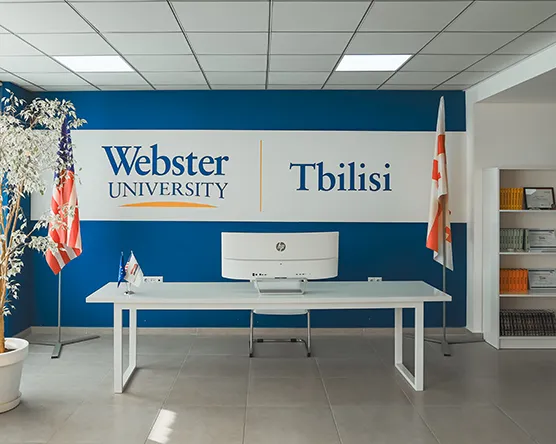
Webster University Tbilisi Campus
82 Ilia Chavchavadze Avenue
Tbilisi, Georgia
Connect with Us
Internationalization of Higher Education: Practices and Challenges of ‘Going Global’
February 5, 2026
Global Student Leadership Summit Empowers Students to Lead Across Borders
May 27, 2025
From May 18 to 23, a group of 23 undergraduate student leaders from across the Webster global network gathered at the...

Webster University Georgia Celebrates Three Years, First Graduation Ceremony
October 16, 2024